New
Turn ordinary chats into extraordinary experiences! Experience Iera.ai Visit Now

TL;DR

Enterprise ML pipeline tools can transform how organizations move from raw data to production-ready models, and according to Gartner, only 48% of AI projects make it to production, taking an average of 8 months to deploy.

NexML’s unified MLOps workflow streamlines this journey through automated machine learning pipelines, compliance-first design, and an end-to-end model deployment workflow. It directly addresses the critical gap between ML experimentation and production deployment that costs enterprises millions in failed projects.

Introduction

The whole machine learning thing has reached its critical inflection point, while the majority of large enterprises have adopted MLOps platforms to optimize their ML lifecycle, which is a staggering reality showing 85% of ML projects fail to deliver expected business value, according to Gartner research. The culprit isn’t a lack of talent or inadequate algorithms, but is the absence of robust ML pipeline tools and automated workflows that bridge the gap between experimentation and production.

This guide walks through a complete NexML workflow, demonstrating how enterprise ML workflow automation transforms raw data into production-ready models while maintaining compliance, governance, and operational efficiency.

What Are ML Pipeline Tools and Why Do Enterprises Need Them?

ML pipeline tools are software platforms that automate and orchestrate the complete machine learning lifecycle, from data ingestion through model training, validation, deployment, and monitoring. So, unlike traditional software development, ML systems require specialized infrastructure to handle data dependencies, model versioning, feature engineering, and performance monitoring.

The whole business case is compelling, as companies implementing proper MLOps practices report 40% cost reductions in ML lifecycle management and 97% improvements in model performance. Organizations using ML pipeline tools are 2.5 times more likely to have high-performing machine learning models compared to those relying on manual processes.

The Hidden Cost of Manual ML Workflows

Manual ML workflows create several critical bottlenecks:

Data scientists spend more than 50% of their time on data preparation and infrastructure setup rather than model development. Version control becomes impossible when teams can’t track which data, code, and hyperparameters produced specific model versions. Deployment cycles extend to months instead of days, and production models degrade silently without monitoring infrastructure.

The financial impact is substantial. According to Gartner, at least 30% of generative AI projects will be abandoned after proof of concept by the end of 2025 due to poor data quality, inadequate risk controls, and escalating costs.

The Anatomy of an Automated Machine Learning Pipeline

An effective production ML pipeline tools consists of five interconnected stages that transform raw data into deployed models:

  • Data Ingestion & Validation: Automated collection from databases, files, cloud storage, and APIs with built-in quality checks and schema validation.
  • Feature Engineering & Preprocessing: Transformation pipelines that handle encoding, scaling, imputation, and feature selection while maintaining consistency between training and inference.
  • Model Training & Experimentation: Automated model selection, hyperparameter tuning, and experiment tracking that logs all parameters, metrics, and artifacts.
  • Validation & Approval: Systematic evaluation against hold-out datasets, drift detection, and governance checkpoints before deployment authorization.
  • Deployment & Monitoring: Containerized model serving with continuous performance tracking, alert systems, and automated retraining triggers.

A Day in the Life: Following Data Through the NexML Workflow

Let’s trace a real-world scenario: a financial services company building a credit risk model using NexML’s end-to-end MLOps platform.

Stage 1: Data Scientist – Ingestion to Model Training (Morning)

The day begins with the Data Scientist accessing NexML’s Pipeline Manager. The platform’s data ingestion capabilities support multiple sources, CSV uploads, direct database connections (PostgreSQL, MySQL), and internal S3 buckets.

Our Data Scientist connects to the company’s PostgreSQL database containing historical loan applications. NexML automatically validates data schemas and flags quality issues. The preprocessing module handles missing values through imputation, encodes categorical variables, scales numerical features, and performs feature selection, all through an intuitive interface backed by sklearn-based AutoML capabilities.

With preprocessing complete, the Data Scientist selects classification algorithms from NexML’s AutoML suite. The system trains multiple model candidates, comparing Random Forest, XGBoost, and Logistic Regression variants. Each experiment is automatically logged with metrics, parameters, and artifacts that provide complete reproducibility.

After 3 hours of iterative refinement, the model achieves the target accuracy, and the Data Scientist exports the model, changing its status to “Staging”, ready for validation.

Stage 2: Manager – Batch Inference & Approval (Midday)

The Manager receives notification that a new model requires approval. Using NexML’s Batch Inference module, they test the staged model against recent unseen data.

The platform generates comprehensive reports:

Prediction performance on new data samples. Data drift analysis comparing training vs. current distributions. Explainability reports showing feature importance and decision factors for regulatory compliance.

The results are promising, and accuracy remains stable, drift metrics are within acceptable thresholds, and explanations align with business logic. The manager approves the model through NexML’s governance workflow, promoting it to “Approved” status.

Stage 3: Manager – Production Deployment (Afternoon)

Now, with approval granted, the manager navigates to Deployment Manager. NexML currently offers a full functional EC2 deployment (with ASG and Lambda deployment options in development). The manager selects deployment specifications:

Environment: On-Server (EC2). Instance size: Medium (optimized for production workload). Auto-provisioning: Enabled for automatic endpoint creation.

Within minutes, NexML containerizes the model, provisions infrastructure, and exposes a secure prediction endpoint. The entire model deployment workflow, which traditionally takes weeks, is completed in under 15 minutes.

Stage 4: Manager – Dynamic Routing Configuration (Late Afternoon)

The company needs to route predictions based on loan amount thresholds, and using Manage Model Config, the Manager creates intelligent routing logic:

IF loan_amount > 100000 THEN use risk_model_v2
ELSE use risk_model_v1

NexML’s nested AND/OR condition builder supports complex routing scenarios. A secure routing key is generated, providing a single unified endpoint that intelligently directs requests to appropriate model versions based on input characteristics.

Stage 5: CTO – Compliance Setup & Governance (Evening)

Before the model processes customer applications, the CTO registers it for compliance monitoring through Compliance Setup. NexML’s compliance-centric design integrates fairness, consent, provenance, and audit tracking as first-class citizens.

The CTO completes 12 configurable sections (6 mandatory fields):

Model information and purpose, Domain context and use cases, Fairness and bias mitigation strategies, Data provenance and lineage, Risk assessment and monitoring protocols, and Audit requirements and retention policies.

Once configured, NexML automatically generates monthly compliance reports including drift analysis, fairness metrics, consent tracking, and audit trails. The computed compliance score provides quantitative governance metrics for regulatory reporting.

Stage 6: Continuous Monitoring & Audit Trail (Ongoing)

As the model is in production, NexML’s Audit Trail captures every prediction with full traceability. The CTO and Manager can filter predictions by date range, access explanations for individual outputs, and monitor real-time performance metrics.

Audit Reports provide comprehensive monthly assessments:

Model performance trends and accuracy metrics. Data drift indicators across feature distributions. Fairness analysis across protected demographic groups. Compliance adherence scoring.

If any performance degradation is detected, automated alerts trigger the retraining workflow, and ultimately bring the cycle full circle back to the Data Scientist.

How Automation Simplifies the Enterprise ML Workflow

The contrast between manual and automated approaches is stark, as Traditional ML workflows require data engineers to write custom ETL scripts, data scientists to manually track experiments in spreadsheets, DevOps teams to build custom deployment infrastructure, and compliance officers to generate reports through manual data collection.

Automated machine learning pipelines eliminate these bottlenecks:

  • Version control is automatic. Every dataset, preprocessing step, model version, and deployment configuration is tracked with full lineage.
  • Reproducibility is guaranteed. Any model can be recreated from historical metadata, critical for regulatory audits and debugging.
  • Deployment is standardized. Containerization and infrastructure provisioning happen automatically, eliminating environment inconsistencies.
  • Monitoring is continuous. Performance metrics, drift detection, and compliance scoring run automatically without manual intervention.

According to industry research, automation enables organizations to deploy and maintain hundreds, maybe thousands, of models simultaneously, which is a scale impossible with manual processes.

How MLOps Workflow Reduces Manual Effort

The MLOps workflow fundamentally restructures how teams collaborate. Instead of siloed handoffs where data scientists “throw models over the wall” to IT operations, MLOps creates a unified platform where all stakeholders work within shared infrastructure.

Eliminating the Deployment Bottleneck

In traditional workflows, model deployment requires too much back-and-forth between data scientists and IT teams. The Data Scientists team lacks infrastructure expertise, and DevOps Engineers lack the ML domain knowledge, which causes deployment cycles stretching 8+ months and 80% of ML projects failing to reach production.

NexML’s role-based design solves this through intelligent separation of concerns:

Data Scientists focus on model quality within Pipeline Manager, Managers handle the deployment decisions without needing any infrastructure expertise, CTOs can maintain the while governance oversight through compliance dashboards, and finally, IT teams can manage underlying infrastructure without touching ML logic.

This division reduces manual coordination while maintaining clear accountability.

Accelerating Iteration Cycles

Manual ML workflows create expensive feedback loops, and a data scientist trains a model, wait for days for IT to deploy it, discover a bug, and then wait again for redeployment. With each iteration consuming weeks of time.

Automated MLOps workflow compresses this timeline:

Pipeline Manager provides instant model training with automatic experiment tracking. Batch Inference enables rapid validation on new data before deployment commitment. Deployment Manager provisions infrastructure in minutes rather than weeks. Audit Trail provides immediate feedback on production performance.

Organizations report reducing model iteration time from weeks to hours, which is like a 10-20x acceleration in the development cycle.

Key Steps in a Model Deployment Workflow

A robust model deployment workflow requires more than simply exposing a trained model via API. Enterprise-grade deployment encompasses six critical phases:

  • Pre-Deployment Validation: Comprehensive testing against hold-out data, drift analysis, performance benchmarking, and bias assessment. NexML’s Batch Inference module automates this validation before any production commitment.
  • Approval & Governance Gate: Formal review by managers or compliance officers ensuring that model meets business requirements, complies with regulatory standards, and passes fairness criteria. NexML’s approval workflow provides documented audit trails for these decisions.
  • Infrastructure Provisioning: Automated container creation, resource allocation, load balancer configuration, and endpoint exposure. NexML’s Deployment Manager handles this complexity, supporting EC2 environments with ASG and Lambda options in development.
  • Dynamic Routing Configuration: For enterprises managing multiple model versions, intelligent routing based on input characteristics is essential. NexML’s Manage Model Config enables rule-based routing with nested logical conditions.
  • Monitoring & Alerting: Continuous tracking of prediction accuracy, feature drift, data quality issues, and compliance metrics. NexML’s Audit Reports and Audit Trail provide comprehensive observability.
  • Retraining Triggers: Automated workflows that detect performance degradation and initiate model updates. Integration between monitoring systems and Pipeline Manager enables closed-loop intelligence.

Best Practices for Production ML Pipelines

Research across enterprise deployments reveals several non-negotiable best practices:

  • Treat Data as a First-Class Citizen: Poor data quality causes 85% of AI project failures, according to Gartner. Implement automated data validation, versioning, and quality monitoring from day one.
  • Version Everything: Code, data, features, hyperparameters, and models must be versioned together, as without lineage, reproducibility becomes impossible, which is a critical failure point for regulated industries.
  • Automate Testing: Implement automated testing for data quality, model performance, fairness metrics, and deployment health. Manual testing doesn’t scale to enterprise model portfolios.
  • Embrace Compliance by Design: Waiting until deployment to address compliance is too late. Platforms like NexML that integrate compliance requirements into the core workflow prevent regulatory surprises.
  • Monitor Continuously: Model performance degrades over time due to data drift, concept drift, and changing business conditions. Real-time monitoring with automated retraining triggers is essential.
  • Maintain Governance Without Sacrificing Velocity: Role-based access control, approval workflows, and audit trails enable compliance without blocking innovation. NexML’s hierarchical roles (SuperAdmin/CTO, Manager, Compliance Manager, Data Scientist) balance governance with autonomy.

The Competitive Advantage of Unified MLOps Platforms

The MLOps market is experiencing explosive growth rate, reaching $1.7 billion in 2024 with projections of $129 billion by 2034, representing a 43% compound annual growth rate, and this acceleration reflects a urgent need for scalable ML infrastructure.

However, 72% of the MLOps market consists of platforms rather than point solutions. Why? Fragmented toolchains create integration nightmares. Data scientists use one tool for experiments, another for deployment, and yet another for monitoring. Each integration point introduces friction, manual handoffs, and potential failure modes.

Unified platforms like NexML eliminate this complexity through single-interface management:

Pipeline Manager handles the data ingestion through model training, Deployment Manager manages production infrastructure. Compliance Setup and Audit Reports provide governance oversight, and Manage Model Config enables intelligent routing.

This integration delivers tangible business outcomes. Netflix, for example, reduced model deployment time from weeks to hours using unified MLOps platforms, enabling them to test and deploy recommendation algorithms across their global user base while maintaining 99.9% uptime.

Addressing Common MLOps Challenges

Despite the maturity of MLOps tooling in 2026, enterprises still encounter predictable challenges:

Challenge: The Skills Gap

Traditional software engineers struggle with ML concepts like statistical significance and model drift. Data scientists lack production engineering experience, and this skills mismatch creates operational blind spots.

NexML’s Solution: Role-based design allows each stakeholder to work within their expertise, such as Data Scientists can only focus on model quality, Managers can handle operational decisions, while CTOs can maintain governance oversight. No single person needs end-to-end ML+DevOps expertise.

Challenge: Data Drift & Model Decay

Production data differs dramatically from controlled development datasets. Models trained on historical data degrade as distributions shift.

NexML’s Solution: Batch inference generates comprehensive drift reports before deployment. Audit Trail tracks prediction patterns over time, Automated alerts trigger retraining workflows when performance thresholds are breached.

Challenge: Compliance & Governance

Financial services, healthcare, and regulated industries face strict requirements for model explainability, fairness, and auditability.

NexML’s Solution: Compliance-centric design treats governance as a first-class concern rather than some afterthought. Automated compliance reports, audit trails, and fairness analysis are built into the core platform, and not just bolted on post-deployment.

The Future of Enterprise ML Pipeline Tools Workflows

As we progress through 2026, several trends are reshaping the MLOps landscape:

  • Hyper-Automation: Workflows that can retrain and redeploy models autonomously, learning and adapting without any human intervention, are becoming standard for high-velocity enterprises.
  • Edge Computing Integration: Organizations are deploying localized AI solutions that respond in real-time on edge devices, which is requiring specialized deployment architectures beyond the traditional cloud-centric approaches.
  • LLM & Foundation Model Integration: The rise of large language models have introduced a new complexity in prompt engineering, RAG (Retrival-Augmented Generation) pipelines, and agent orchestration, which is expanding MLOps beyond traditional supervised learning.
  • Regulatory Compliance Automation: As frameworks like USa’s AI Act mature, automated compliance verification will transition from a competitive advantage to table stakes.

NexML’s roadmap addresses these trends through planned enhancements such as model accuracy tracking via user feedback loops, guided workflow templates for teams with minimal ML maturity, enhanced monitoring dashboards, and extended integrations with external cloud storage providers.

Conclusion

The gap between ML experimentation and production deployment has claimed countless enterprise initiatives, and is costing organizations millions in failed projects and missed opportunities.

The solution isn’t more sophisticated algorithms or bigger datasets, but is a comprehensive ML pipeline tools that automate the complete model deployment workflow while maintaining governance, compliance, and operational reliability.

NexML’s unified platform demonstrates how enterprises can bridge this gap through automated ML pipelines tools, role-based workflows that align with organizational structure, compliance-first design for regulated industries, and end-to-end visibility from data ingestion through production monitoring.

The data is very clear: organizations implementing robust MLOps practices are achieving 40% cost reductions, 97% performance improvements, and 2.5x likelihood of deploying high-performing models.

Now, for CTOs and Data Science leaders navigating this complex journey from prototype to production, the question is no longer whether to adopt MLOps, but it’s about which platform will enable your team to join the 48% of projects that successfully reach production.

Ready to transform your ML operations? Contact us to discuss how NexML’s compliance-first MLOps platform can accelerate your journey from data source to production deployment.

profile-thumb
Neil Taylor
March 11, 2026

Meet Neil Taylor, a seasoned tech expert with a profound understanding of Artificial Intelligence (AI), Machine Learning (ML), and Data Analytics. With extensive domain expertise, Neil Taylor has established themselves as a thought leader in the ever-evolving landscape of technology. Their insightful blog posts delve into the intricacies of AI, ML, and Data Analytics, offering valuable insights and practical guidance to readers navigating these complex domains.

Drawing from years of hands-on experience and a deep passion for innovation, Neil Taylor brings a unique perspective to the table, making their blog an indispensable resource for tech enthusiasts, industry professionals, and aspiring data scientists alike. Dive into Neil Taylor’s world of expertise and embark on a journey of discovery in the realm of cutting-edge technology.

Frequently Asked Questions

ML pipeline tools are software platforms that automate the complete machine learning lifecycle from data ingestion through model deployment and monitoring. Enterprises need them because manual ML workflows cause 85% of projects to fail due to deployment bottlenecks, version control challenges, and lack of monitoring infrastructure. Organizations using ML pipeline tools achieve 40% cost reductions and 97% performance improvements while scaling to manage hundreds of production models simultaneously.

An end-to-end machine learning workflow consists of five interconnected stages: data ingestion and validation from multiple sources, feature engineering and preprocessing with transformation pipelines, model training and experimentation with automated tracking, validation and approval through governance checkpoints, and deployment with continuous monitoring. This complete cycle typically takes 8 months on average in traditional manual workflows, but can be compressed to days with proper automation.

Automation eliminates manual bottlenecks where data scientists spend over 50% of their time on infrastructure setup rather than model development. Automated pipelines provide instant version control for all artifacts, guaranteed reproducibility for audits and debugging, standardized deployment eliminating environment inconsistencies, and continuous monitoring without manual intervention. This allows teams to iterate 10-20x faster and maintain hundreds of production models that would be impossible to manage manually.

MLOps workflow reduces manual effort by creating unified platforms where stakeholders work within shared infrastructure rather than through siloed handoffs. Data scientists focus on model quality, managers handle deployment decisions without infrastructure expertise, and CTOs maintain governance through compliance dashboards. This eliminates expensive feedback loops where deployment requires weeks of back-and-forth between teams. Organizations report reducing model iteration time from weeks to hours and increasing production deployment success rates from 15% to 48%.

The six critical phases of model deployment workflow are: pre-deployment validation, including drift analysis and bias assessment; approval and governance gates with documented audit trails; infrastructure provisioning through automated containerization and resource allocation; dynamic routing configuration for managing multiple model versions; monitoring and alerting for continuous performance tracking; and retraining triggers that detect degradation and initiate automated updates. Enterprise-grade deployment requires all six phases working together not just exposing a trained model via API to ensure reliability, compliance, and long-term operational success.
Table of Contents

Ready to Revolutionize your Business with Advanced Data Analytics and AI?

TL;DR

Enterprise AI deployment demands a robust ML model monitoring infrastructure capable of managing hundreds of production models simultaneously, and organizations face critical challenges, such as including drift detection, compliance requirements, and operational governance at scale.

NexML addresses these complexities through an integrated MLOps and Compliance Management Solution that combines automated monitoring, role-based governance, and continuous audit capabilities, and this enables enterprises to deploy, monitor, and maintain AI systems securely while meeting regulatory standards.

Financial institutions, healthcare providers, and regulated industries are scaling AI operations with platforms that prioritize compliance-first design alongside operational excellence.

The Enterprise AI Deployment Challenge

The artificial intelligence world has reached a critical inflection point in 2026, and according to a recent market research, 78% of large enterprises now actively deploy machine learning models in production environments, compared to just 35% in 2020.

This explosive growth creates crazy amounts of operational complexity, and organizations no longer manage a handful of experimental models, and they operate hundreds of thousands simultaneously across multiple business functions.

The MLOps market reflects this surge in demand, and market valuations have grown from $3.19 billion in 2025 to a projected $73.7 billion by 2035, representing a 41.8% compound annual growth rate.

Scale Brings Complexity

Modern enterprises face three fundamental deployment challenges:

  • Model drift and performance degradation: Research shows that 91% of machine learning models suffer from drift, where changing data patterns erode prediction accuracy over time, and what performs a 95% accuracy in testing may deliver only 87% in production months later.
  • Regulatory compliance requirements:
    65% of organizations cite regulatory compliance as a primary driver for MLOps investment. Financial services firms face stringent model risk management frameworks, and Healthcare providers must maintain HIPAA compliance and audit trails.
  • Operational governance at scale: As a model counts grow from dozens to hundreds, manual monitoring becomes impossible. Organizations need automated systems that detect issues, trigger alerts, and maintain comprehensive audit records.

Why ML Model Monitoring is Mission-Critical?

Machine learning model monitoring forms the operational backbone of enterprise AI infrastructure, and unlike traditional software, ML models degrade silently without errors or exceptions, and they continue running while prediction quality deteriorates.

Model Drift: The Silent Performance Killer

Model drift manifests in two primary forms that require different detection approaches.

  • Data driftoccurs when input feature distributions change relative to training data, and a credit risk model trained on 2021-2023 customer data may encounter dramatically different demographic patterns by 2026, and the relationship between features and outcomes remains valid, but the distribution shifts.
  • Concept driftappens when fundamental relationships change. Fraud tactics evolve, regulatory environments shift, and consumer behaviors transform, and the model’s learned patterns no longer apply to current reality.

Organizations implementing comprehensive monitoring report 40% cost reductions in ML lifecycle management and 97% improvements in model performance compared to manual oversight approaches.

Compliance and Model Risk Management

Financial services institutions face particularly stringent requirements. The BFSI sector accounts for 22% of the global MLOps market, driven primarily by regulatory demands for model transparency, auditability, and version control.

Model risk management frameworks require:

  • Comprehensive documentation of model development and validation
  • Continuous performance monitoring with automated alerting
  • Drift detection and remediation procedures
  • Audit trails track every prediction and decision
  • Explainability mechanisms for regulatory review

Organizations without proper monitoring infrastructure face significant compliance risks, operational failures, and potential regulatory penalties.

NexML’s Approach to Secure Model Deployment

NexML addresses enterprise AI deployment challenges through an integrated platform combining MLOps automation with compliance-first design, and the solution manages the complete model lifecycle from development through production monitoring.

Unified Platform Architecture

NexML provides a centralized environment where data scientists, managers, and technology leaders collaborate through role-based access controls, and this structure ensures appropriate governance at every stage.

The platform integrates several core capabilities:

  • Model lifecycle automation enables complete workflows from data ingestion and preprocessing through training, deployment, and continuous monitoring. Organizations automate repetitive tasks while maintaining quality controls.
  • Compliance-centric operations integrate fairness analysis, consent management, and audit tracking as fundamental platform features rather than add-ons. This design prioritizes regulatory requirements from the start.
  • Dynamic deployment and routing allows flexible infrastructure choices, and models deploy to EC2 instances with configurable sizing (small, medium, large) based on performance requirements. Organizations can route prediction requests intelligently across multiple models using rule-based logic.

Role-Based Governance

NexML implements hierarchical access controls tailored to enterprise organizational structures:

  • Data Scientists access Pipeline Manager for model development, Process Manager for job monitoring, and Batch Inference for validation testing. They cannot deploy or approve models for production.
  • Managers review batch inference results, approve models for deployment, configure routing rules, and register models for compliance monitoring, and they bridge development and production operations.
  • CTOs and Compliance Officers maintain platform-wide visibility, access comprehensive audit reports, review compliance scores, and establish governance policies.

This separation of duties ensures appropriate oversight while maintaining operational efficiency.

Model Monitoring Tools and Framework

Effective machine learning model monitoring requires systematic approaches to detection, measurement, and remediation. NexML provides integrated monitoring capabilities addressing both technical performance and regulatory requirements.

Continuous Model Evaluation

The Batch Inference module enables ongoing model validation against new data. Organizations test exported models with CSV uploads or internal S3 data to validate predictions, detect drift, and assess explainability before production deployment.

This pre-deployment validation catches performance degradation early, and models showing drift or declining accuracy metrics remain in staging until teams investigate and retrain.

Production Monitoring Infrastructure

Once deployed, models enter continuous monitoring through several mechanisms:

  • Audit Trail tracking records and prediction-level data for complete transparency and traceability. Managers and CTOs can filter predictions by date range and access explanations for individual outputs, and this granular tracking supports both troubleshooting and regulatory review.
  • Automated compliance reporting generates monthly audit reports incorporating drift analysis, explanation metrics, and compliance scoring. Organizations can also generate custom reports for specific date ranges when regulatory reviews or internal audits require detailed documentation.

The Audit Report module consolidates multiple monitoring dimensions: audit logs, performance metrics, explanation analysis, drift detection results, and compliance assessments, and this whole unified view enables rapid issue identification.

Model Drift Detection Framework

NexML’s Batch Inference module provides drift and explanation reports as core validation outputs, and these reports enable teams to:

  • Compare statistical distributions between training and production data
  • Identify features showing significant drift
  • Quantify drift magnitude and direction
  • Assess whether drift impacts prediction quality

When drift exceeds acceptable thresholds, the approval workflow prevents production deployment until teams address the underlying causes through retraining or feature engineering.

Secure Deployment at Scale

Managing hundreds of models requires infrastructure that balances security, performance, and operational efficiency. NexML’s deployment architecture addresses these requirements through flexible infrastructure options and centralized governance.

Multi-Model Deployment Management

The Deployment Manager enables operational teams to deploy approved models across infrastructure environments. Currently, EC2 deployment is fully operational with configurable instance sizes optimizing cost-performance tradeoffs.

Organizations select instance sizing based on model complexity and performance requirements:

  • Small instances handle lightweight models with moderate request volumes
  • Medium instances support standard production workloads
  • Large instances accommodate complex models requiring significant computational resources

ASG (Auto Scaling Groups) and Lambda (serverless) deployment options are currently in development, expanding infrastructure flexibility for different use cases.

Dynamic Routing and Endpoint Management

The Manage Model Config module solves a critical challenge: how to intelligently route prediction requests across multiple model versions or variants.

Organizations create routing keys defining rule logic for request distribution. For example: route credit applications where applicant_age > 40 to model_version_2, otherwise use model_version_1.

The nested AND/OR condition builder enables sophisticated routing rules accommodating complex business logic. Multiple models serve behind a single secure endpoint, with routing occurring transparently based on input features.

This capability is essential for:

  • A/B testing different model versions
  • Gradual rollout of updated models
  • Segmented model strategies serving different customer populations
  • Champion-challenger testing frameworks

Generated routing keys provide secure access to unified endpoints, maintaining security while simplifying client integration.

Centralized Model Governance

The Manage Model module provides a central control plane for viewing and controlling all deployed models, and the Technology leaders access models by version and status, terminate authorized models when needed, and access comprehensive model insights.

This centralized visibility is crucial when operating at scale, and rather than tracking models across disparate systems, teams maintain a single source of truth showing:

  • Which models are currently deployed
  • What versions are running in production
  • Performance metrics and health status
  • Deployment configurations and routing rules

Compliance Management for Regulated Industries

Financial services, healthcare, and other regulated sectors require ML platforms that prioritize compliance alongside technical capabilities. NexML’s Compliance Setup module addresses these requirements through structured frameworks and automated reporting.

Structured Compliance Framework

The Compliance Setup module implements a 12-section compliance framework covering critical model governance areas. Six sections require manual completion through the user interface, while others populate automatically from system data.

Key compliance dimensions include:

  • Model information and technical documentation
  • Domain context and use case descriptions
  • Fairness and bias analysis
  • Consent and data provenance tracking
  • Performance metrics and validation results
  • Ongoing monitoring and maintenance procedures

This structured approach ensures consistent documentation across all models subject to regulatory oversight.

Automated Compliance Scoring

NexML computes compliance scores based on framework completion and configuration settings, and these scores provide quantitative assessments of model readiness for regulatory review.

The Manage Compliance Config module allows organizations to customize which compliance sections apply to specific models, and this flexibility accommodates varying regulatory requirements across different jurisdictions and use cases.

Monthly Audit Reports

Automated monthly reporting generates comprehensive compliance documentation without manual compilation. Reports incorporate:

  • Audit logs showing all model interactions
  • Performance metrics tracking prediction accuracy
  • Drift analysis identifying distribution changes
  • Compliance scoring reflecting framework adherence
  • Explanation analysis for model interpretability

Organizations also generate custom date-range reports when regulatory examinations, internal audits, or specific incidents require detailed documentation.

Implementation Best Practices

Successful enterprise AI deployment requires more than technical capabilities, and it demands organizational alignment, clear processes, and ongoing governance. Organizations scaling to hundreds of models should consider these proven approaches.

Start with Strong Foundations

Establish clear role definitions and access controls before scaling operations. NexML’s role-based architecture supports this through predefined hierarchical roles: SuperAdmin/CTO, Manager, Compliance Manager, and Data Scientist.

These roles map to organizational responsibilities, ensuring appropriate oversight without creating bottlenecks. Technology leaders maintain platform-wide visibility while empowering teams to work efficiently within their domains.

Implement approval workflows for production deployment. The staged progression from model export through batch inference validation to manager approval prevents unvetted models from reaching production.

This gate-keeping approach balances velocity with quality assurance, and Data scientists iterate rapidly in development, while managers ensure production-bound models meet standards.

Build Compliance Into Development Workflows

Organizations in regulated industries should integrate compliance considerations from the start rather than treating them as deployment-time add-ons.

  • Complete compliance documentation during development. Data scientists can populate required compliance sections (model_info, domain_context, fairness_bias) while models remain in development, and whole front-loads compliance work rather than creating bottlenecks at deployment.
  • Leverage batch inference for compliance validation. Test models against diverse data samples representing production scenarios, and evaluate not just accuracy but also fairness metrics, explanation quality, and drift characteristics.
  • Maintain comprehensive audit trails from day one. NexML’s Audit Trail feature tracks prediction-level data, creating transparency and traceability that support both troubleshooting and regulatory review.

Establish Monitoring Cadences

Effective model monitoring requires regular review cycles rather than reactive fire-fighting.

  • Schedule monthly compliance reviews aligned with automated report generation. Compliance managers and CTOs should systematically review model performance, drift indicators, and compliance scores.
  • Define clear escalation paths when monitoring identifies issues. Automated alerts should route to appropriate teams based on severity. Minor drift might trigger a data science review, while compliance violations require immediate management attention.
  • Plan retraining cycles proactively, so rather than waiting for model degradation, establish scheduled retraining based on expected data evolution patterns. Financial services models might require quarterly updates, while fraud detection models need more frequent refreshes.

Common Challenges and Solutions

Organizations scaling AI operations encounter predictable challenges. Understanding these patterns enables proactive mitigation.

Challenge: Monitoring Hundreds of Models Simultaneously

Manual monitoring breaks down at scale. Teams cannot review dashboards for hundreds of models daily.

  • Solution: Automated alerting and exception-based management. Configure threshold-based alerts that notify teams only when models require attention. NexML’s Audit Report module consolidates monitoring across multiple models, enabling teams to identify outliers rather than reviewing each model individually.

Challenge: Maintaining Consistent Compliance Documentation

Without structured frameworks, compliance documentation varies wildly across models, creating audit risk.

  • Solution: Templated compliance frameworks with required fields. NexML’s 12-section structure ensures consistent documentation. The Manage Compliance Config module allows tailoring while maintaining baseline requirements.

Challenge: Coordinating Across Data Science and Operations Teams

Model handoffs between development and production often fail due to missing context, incomplete documentation, or unclear responsibilities.

  • Solution: Role-based workflows with clear gates and approval processes. NexML’s architecture separates development (data scientists) from deployment (managers) while maintaining information continuity through comprehensive model metadata and batch inference validation.

Measuring Success and ROI

Organizations implementing structured ML monitoring and deployment frameworks report significant improvements across multiple dimensions.

Operational Efficiency Gains

  • Reduced deployment time: Automated workflows accelerate model progression from development to production, and organizations report deployment cycles shortening from weeks to days.
  • Lower maintenance overhead: Automated monitoring and alerting reduce manual review burden. Teams focus attention on models requiring intervention rather than checking all models routinely.
  • Improved collaboration: Role-based workflows with clear handoffs points reduce friction between data science and operations teams, and batch inference validation provides a common ground for evaluating production readiness.

Risk Reduction Benefits

  • Early drift detection: Continuous monitoring catches performance degradation before it impacts business operations, and the organizations identify and address drift in weeks rather than months.
  • Compliance readiness: Structured documentation and automated reporting dramatically reduce audit preparation time. Comprehensive audit trails provide evidence supporting regulatory examinations.
  • Model governance: Centralized visibility into all deployed models enables rapid issue identification and remediation. Organizations maintain clear inventory of production AI systems.

Cost Optimization

  • Infrastructure efficiency: Dynamic deployment with right-sized instances optimizes compute costs. Organizations avoid both under-provisioning (performance issues) and over-provisioning (wasted resources).
  • Reduced regulatory risk: Compliance violations carry significant financial penalties. Proper governance frameworks minimize exposure to regulatory sanctions and reputational damage.
  • Lower operational costs: Automation reduces manual labor requirements for monitoring, reporting, and compliance documentation.

Conclusion

Enterprise AI has reached a critical maturity point where operational excellence determines success, and now organizations can deploy hundreds of models across critical business functions, making robust ML model monitoring infrastructure non-negotiable.

NexML addresses this challenge through integrated MLOps and compliance management designed specifically for regulated industries. The platform combines model lifecycle automation, role-based governance, continuous monitoring, and compliance-first design into a unified solution.

Financial services institutions managing model risk management frameworks, healthcare providers maintaining HIPAA compliance, and regulated enterprises scaling AI operations require platforms that balance operational efficiency with governance rigor.

As AI systems become increasingly central to business operations, the organizations that succeed will be those investing in proper infrastructure for deployment, monitoring, and governance at scale.

Ready to scale your AI operations securely? Contact NexML to learn how our MLOps and Compliance Management Solution enables enterprises to deploy hundreds of models while maintaining regulatory compliance and operational excellence.

profile-thumb
Neil Taylor
March 6, 2026

Meet Neil Taylor, a seasoned tech expert with a profound understanding of Artificial Intelligence (AI), Machine Learning (ML), and Data Analytics. With extensive domain expertise, Neil Taylor has established themselves as a thought leader in the ever-evolving landscape of technology. Their insightful blog posts delve into the intricacies of AI, ML, and Data Analytics, offering valuable insights and practical guidance to readers navigating these complex domains.

Drawing from years of hands-on experience and a deep passion for innovation, Neil Taylor brings a unique perspective to the table, making their blog an indispensable resource for tech enthusiasts, industry professionals, and aspiring data scientists alike. Dive into Neil Taylor’s world of expertise and embark on a journey of discovery in the realm of cutting-edge technology.

Frequently Asked Questions

ML model monitoring tracks machine learning model performance in production environments, detecting drift, performance degradation, and compliance issues. It’s critical because 91% of ML models degrade over time due to changing data patterns, and without monitoring, organizations face silent failures that impact business operations and regulatory compliance.

Enterprises detect drift by comparing statistical distributions of production data against training data, monitoring performance metrics over time, and using automated drift detection algorithms. NexML’s Batch Inference module generates drift reports quantifying distribution changes, while Audit Trail tracking enables granular analysis of prediction patterns over time.

Key challenges include manual monitoring becoming impossible at scale, maintaining consistent compliance documentation across models, coordinating between data science and operations teams, and detecting issues before they impact business operations. Organizations need automated alerting, standardized frameworks, and role-based workflows to manage complexity effectively.

MLOps platforms provide automated monitoring infrastructure, centralized visibility across all deployed models, role-based governance preventing unauthorized changes, comprehensive audit trails for regulatory compliance, and automated alerting when models require attention. This enables teams to manage hundreds of models with exception-based oversight rather than manual review.

Model evaluation occurs during development and deployment, testing model performance against validation data before production. Continuous model monitoring tracks performance after deployment, detecting drift and degradation in real-world conditions. Both are essential—evaluation prevents poor models from reaching production, while monitoring ensures production models maintain quality over time.

Table of Contents

Ready to Revolutionize your Business with Advanced Data Analytics and AI?

TL;DR

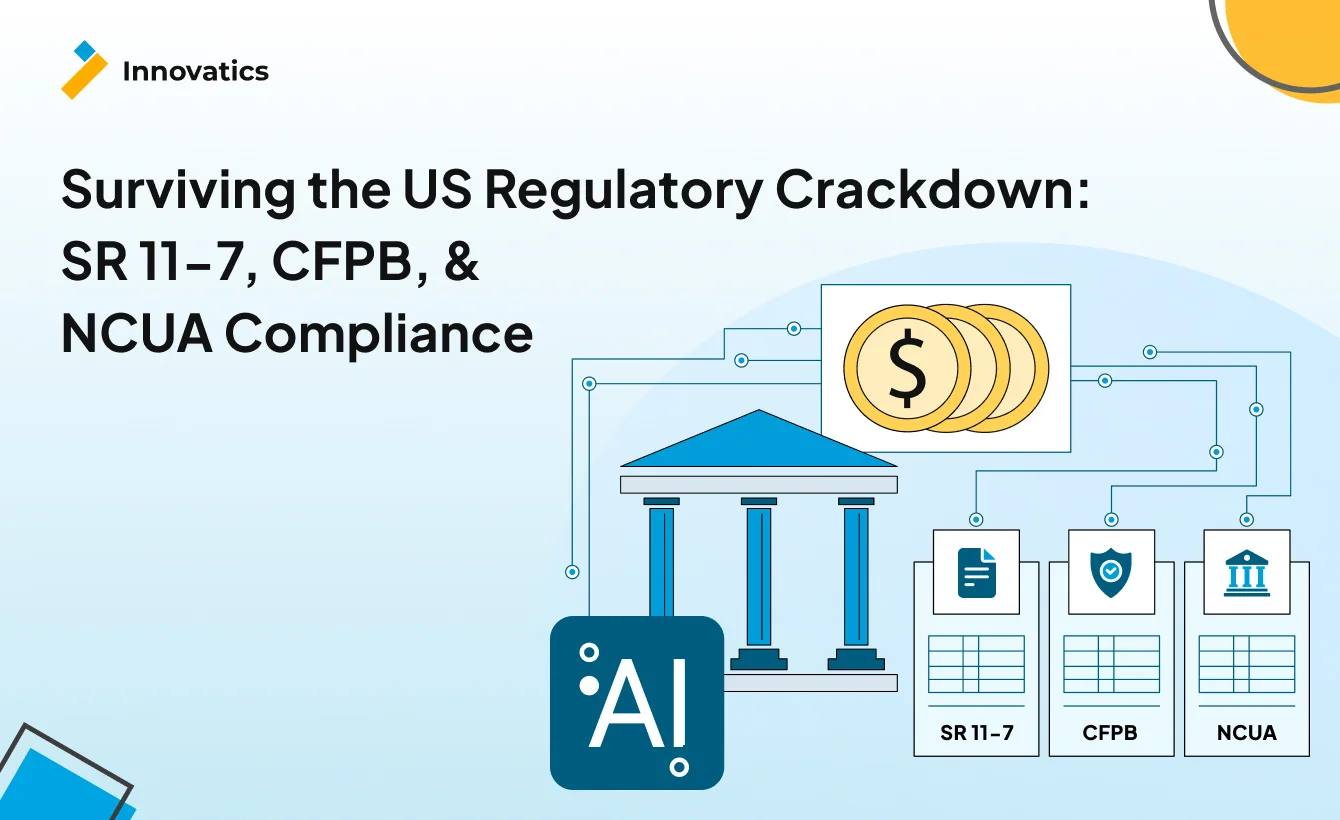
US financial institutions are facing unprecedented regulatory pressure from SR 11-7, CFPB, and NCUA enforcement. Now, with 42% of AI projects failing before production and $4.6B in global AML fines just in 2024, AI compliance platforms are no longer optional, as they are essential for survival.

The regulatory landscape for machine learning in US finance has fundamentally shifted.

Financial institutions are navigating a complex convergence of strict SR 11-7 enforcement by the OCC and FED, the CFPB’s aggressive algorithmic fairness crackdown, and the NCUA’s comprehensive 2025 AI Compliance Plan.

The data reveals a sobering reality. According to S&P Global Market Intelligence’s 2025 survey, 42% of financial services companies abandoned 46% of their AI proof-of-concepts before reaching production.

When you combine these deployment failures with $4.6 billion in global AML fines issued in 2024 and a 417% increase in penalties during the first half of 2025, the business case for an AI compliance platform becomes undeniable.

Why Traditional MLOps Fails Regulatory Requirements

The fundamental issue isn’t technological capability, but architectural philosophy.

Most ML development follows a fragmented workflow. Data scientists build models in Jupyter notebooks, DevOps teams handle deployment separately, and compliance teams manually assemble documentation when OCC or NCUA examiners arrive.

This disconnected approach creates three critical regulatory failures:

Incomplete Audit Trails

SR 11-7 requires models to be fully reproducible. When training happens in one environment and deployment in another, reconstructing decision lineage becomes manual archaeology. Without unified tracking provided by an AI governance platform, institutions cannot demonstrate the “Effective Challenge” regulators demand.

Retrofitted Compliance

Adding fairness checks after a model reaches production is dangerous. Rexer Analytics data shows compliance gaps are a significant factor in the 78% of ML initiatives that fail to deploy. When fairness testing is bolted on as an afterthought, you risk violating Fair Lending laws by missing early stages where bias is introduced.

Cloud Vendor Lock-In

Cloud-only MLOps platforms create data sovereignty concerns under GLBA and heighten third-party risk. Goldman Sachs estimates AI technology investments will total $200 billion globally by the end of 2025. If your compliance infrastructure is locked to a specific cloud vendor, you’ve created a single point of regulatory failure.

The Regulatory Convergence Demanding AI Governance Software

SR 11-7 & OCC Guidelines

For US banks, Supervisory Guidance SR 11-7 (OCC Bulletin 2011-12) remains the gold standard. Regulators have intensified scrutiny on “Effective Challenge” and “Ongoing Monitoring” for AI models.

The guidance explicitly requires:

  • Robust Development: Clear documentation of data lineage and processing
  • Effective Validation: Independence between model developers and validators
  • Ongoing Monitoring: Continuous tracking of model performance and drift
  • Outcome Analysis: Back-testing and verification of actual versus expected results

CFPB & ECOA Explainability Mandate

The Consumer Financial Protection Bureau has made its stance clear: “The algorithm did it” is not a valid legal defense. Under the Equal Credit Opportunity Act (ECOA), lenders must provide specific, accurate reasons for adverse actions.

CFPB Circular 2022-03 (reaffirmed 2025) states that creditors cannot rely on checklist reasons. They must explain the specific data points in the model that led to a denial. Algorithms must be tested for disparate impact against protected classes before and during deployment.

NIST AI RMF & NCUA

The NIST AI Risk Management Framework (RMF), updated in 2025, has become the de facto operational standard for US financial entities.

The NCUA’s 2025 AI Compliance Plan highlights “Safety and Soundness” and “Third-Party Risk,” urging Credit Unions to maintain strict oversight of vendor-supplied AI models using robust AI governance software.

How AI Compliance Platforms Address Regulatory Requirements

An effective AI compliance platform approaches compliance as a first-class citizen, integrating audit, governance, and transparency capabilities that directly map to US banking standards.

Complete Audit Trail & Provenance

  • Regulatory Requirement: SR 11-7 demands “Effective Validation” and the ability to replicate model results. The CFPB requires specific reasons for adverse actions.
  • AI Governance Platform Solution: Advanced platforms track every prediction with complete traceability. Risk Officers and CTOs can easily filter predictions by date range for OCC exams and access detailed explanations for each output. With this level of prediction tracking it ensures that when regulators ask “why did this model deny this loan?”, the answer is immediately available.

Fairness & Bias Documentation

  • Regulatory Requirement: The CFPB and ECOA strictly prohibit discriminatory lending practices. Regulators now test for “disparate impact” in algorithmic decision-making.
  • Enterprise AI Platforms Solution: Compliance modules include fairness and bias documentation as mandatory sections that must be completed before a model can be registered. This structured documentation ensures fairness considerations are captured during development, not retroactively.

AI Risk Management Framework & Monitoring

  • Regulatory Requirement: SR 11-7 mandates “Ongoing Monitoring” to ensure models operate within intended limits. The NIST AI RMF “Manage” function requires continuous treatment of risks.
  • AI Governance Platform Solution: Batch inference capabilities validate models before approval through comprehensive drift detection, and before any model reaches production, managers review drift reports to ensure stability. Once deployed, automated monthly reports on model performance and compliance scores satisfy the “Ongoing Monitoring” requirement of SR 11-7.

Governance & Access Control

  • Regulatory Requirement: The NIST AI RMF “Govern” function and SR 11-7 emphasize clear roles and responsibilities. The NCUA requires Board-level oversight for high-risk AI.
  • AI Compliance Platform Solution: Enterprise platforms implement predefined roles with hierarchical permissions:
    • SuperAdmin/CTO: Full governance oversight
    • Manager: Approval authority for deployment (human-in-the-loop)
    • Compliance Manager: Audit access without deployment privileges
    • Data Scientist: Development only

This structure strictly enforces separation of duties, a key feature of any enterprise-grade AI governance software.

The Cost of Inaction

US financial institutions face a stark choice: invest in AI governance software now, or pay exponentially more later through regulatory penalties and failed projects.

Fenergo’s 2025 research shows that 70% of financial institutions lost clients due to slow onboarding processes, often caused by compliance bottlenecks.

When you combine operational inefficiencies with the aggressive enforcement posture of the CFPB and OCC in late 2025, the financial case for purpose-built AI compliance platforms is overwhelming.

Traditional manual workflows cannot meet the convergent demands of SR 11-7, ECOA, and the NIST AI RMF. Manual processes are too slow. Cloud-only platforms create vendor risk. Neither provides the end-to-end audit trails required by today’s regulatory environment.

Implementation Benefits of AI Governance Platforms

Immediate Audit Readiness

From day one, each and every prediction includes complete traceability, so when the OCC asks for documentation on a credit decision made three months ago, compliance teams can easily retrieve the exact prediction, input data, and explanation instantly.

Automated Monthly Reporting

Instead of manually assembling reports for the Risk Committee, AI compliance platforms generate automated monthly compliance packages including drift analysis and fairness scores.

Scalability

The platform handles multiple models under a single framework, allowing institutions to scale their AI operations without exponentially increasing compliance overhead.

The Path Forward for US Financial Institutions

The regulatory frameworks governing US finance such as SR 11-7, ECOA, and the NIST AI RMF all represent more than just some rules. They represent a fundamental shift in how institutions must approach artificial intelligence.

Compliance-first AI governance platforms aren’t about checking boxes. They’re about building ML systems that are audit-ready from day one.

With AI spending in financial services projected to reach $97 billion by 2027,institutions that master compliant ML operations will gain a decisive competitive advantage.

The question isn’t whether to build compliance-first ML infrastructure. The question is whether you’ll lead this transformation or struggle to catch up. For US banks and credit unions, adopting robust AI governance software is no longer optional—it is the only sustainable path forward.

profile-thumb
Neil Taylor
March 6, 2026

Meet Neil Taylor, a seasoned tech expert with a profound understanding of Artificial Intelligence (AI), Machine Learning (ML), and Data Analytics. With extensive domain expertise, Neil Taylor has established themselves as a thought leader in the ever-evolving landscape of technology. Their insightful blog posts delve into the intricacies of AI, ML, and Data Analytics, offering valuable insights and practical guidance to readers navigating these complex domains.

Drawing from years of hands-on experience and a deep passion for innovation, Neil Taylor brings a unique perspective to the table, making their blog an indispensable resource for tech enthusiasts, industry professionals, and aspiring data scientists alike. Dive into Neil Taylor’s world of expertise and embark on a journey of discovery in the realm of cutting-edge technology.

Frequently Asked Questions

An AI compliance platform is specialized software that integrates compliance, audit trails, and governance capabilities directly into machine learning operations, ensuring models meet regulatory requirements from development through deployment rather than adding compliance as an afterthought.

Unlike traditional MLOps platforms that focus primarily on model development and deployment, an AI governance platform treats compliance, fairness monitoring, and audit trails as first-class features integrated throughout the entire ML lifecycle, specifically designed to meet regulatory frameworks like SR 11-7 and NIST AI RMF.

The NIST AI Risk Management Framework (AI RMF) provides a structured approach for organizations to manage AI-related risks through four core functions: Govern, Map, Measure, and Manage. It has become the de facto operational standard for US financial institutions implementing AI systems.

Financial institutions face unique regulatory requirements under SR 11-7, ECOA, and CFPB guidance that demand complete model traceability, fairness testing, and audit-ready documentation. Generic MLOps tools lack the compliance-specific features required to demonstrate regulatory adherence to examiners.

Enterprise AI platforms ensure SR 11-7 compliance through complete prediction-level audit trails, separation of duties via role-based access control, automated drift monitoring, and continuous performance tracking that satisfies the “Ongoing Monitoring” and “Effective Challenge” requirements mandated by regulators.

Table of Contents

Ready to Revolutionize your Business with Advanced Data Analytics and AI?

TL;DR

The MLOps platform market has reached $3.4 billion in 2026 and is projected to grow at a 28-39% CAGR, driven by enterprises needing secure, compliant machine learning deployment. NexML provides an end-to-end MLOps platform built on enterprise-grade architecture that prioritizes security, regulatory compliance, and deployment flexibility. Unlike other vendor-locked solutions, NexML’s hybrid deployment capabilities deliver 40-70% cost savings while meeting stringent regulatory requirements for financial services and healthcare.

Modern MLOps platforms face a critical challenge: Balancing innovation speed with enterprise security and compliance requirements, and as organizations deploy AI systems at scale, the underlying architecture determines whether models deliver business value or create operational risks.

What Makes Enterprise MLOps Platform Architecture Different

Enterprise ML architecture addresses that consumers ML tools cannot solve. Production machine learning systems require more than model training capabilities, and they demand infrastructure that handles governance, auditability, and compliance as first-class concerns.

Traditional ML platforms treat security and compliance as afterthoughts. Enterprise AI Infrastructure must embed these requirements into the platform’s core architecture from day one, and this architectural difference determines whether organizations can safely deploy models in regulated environments.

The global MLOps market reached $3.4 billion in 2026 and is projected to reach $25.39 billion by 2034. This 28.90% compound annual growth rate reflects increasing enterprise demand for production-grade ML systems that scale securely.

NexML addresses this enterprise need through architecture designed specifically for regulated industries. The platform combines role-based access control, automated audit trails, and configurable compliance frameworks within a unified interface.

Core Architectural Principles of NexML

1. Unified Platform Design

NexML consolidates the complete ML lifecycle into a single platform. Data scientists train models using the Pipeline Manager’s sklearn-based AutoML capabilities. Managers deploy approved models through the Deployment Manager to EC2, ASG, or Lambda infrastructure. CTOs access comprehensive compliance reports and audit trails from a centralized governance interface.

This unified approach eliminates integration complexity, and organizations running disparate tools for training, deployment, and monitoring create security gaps and compliance blind spots. 72% of enterprises report difficulties with data governance frameworks when using fragmented toolchains.

2. Role-Based Security Architecture

Enterprise ML platform security starts with granular access control, and NexML implements hierarchical role structure with feature-level permissions that map to organizational responsibilities.

SuperAdmins control user credentials and API key management, Managers approve model deployments and configure routing logic. Data Scientists access Pipeline Manager and Batch inference without deployment permissions, and Compliance Managers register models for ongoing reporting.

This permission inheritance prevents unauthorized access while enabling collaboration. According to 2026 security research, enterprises now juggle an average of five identity solutions, creating security gaps that attackers exploit through siloed access controls.

Cloud-Agnostic Deployment Architecture

Cloud ML Deployment flexibility separates enterprise platforms from vendor-locked solutions, and NexML supports deployment across EC2 for persistent workloads, Auto Scaling Groups for variable demand, and Lambda for serverless inference.

This architectural choice delivers measurable cost advantages. Organizations deploying on-premise or hybrid infrastructure report 40-70% lower total cost of ownership compared to cloud-only platforms. The savings stem from reduced data egress fees and optimized resource utilization.

The platform’s infrastructure-agnostic design prevents costly migrations when requirements change. Machine learning platform deployments that start in cloud environments frequently need on-premise options as data volumes grow and compliance requirements tighten.

Security Controls for Enterprise ML Architecture

1. Data Security at Every Layer

ML platform security requires protection at rest, in transit, and during processing. NexML implements encryption for stored model artifacts and transmitted predictions. The platform’s access control extends beyond user authentication to secure individual model endpoints through generated routing keys.

ISO 27001 and SOC2 compliance standards now require organizations to demonstrate continuous security monitoring rather than periodic audits. NexML’s architecture supports this shift through automated compliance scoring and drift detection.

2. Audit Trail and Traceability

Every prediction request, model deployment, and configuration change generates audit log entries. This comprehensive traceability meets regulatory requirements while enabling forensic analysis when issues arise.

The Audit Trail feature filters predictions by date range and provides explanation data for each output. Managers and CTOs access this transparency layer to validate model behavior during compliance reviews or incident investigations.

3. Secure API Access Architecture

Production ML systems expose models through APIs that require protection against unauthorized access and abuse. NexML’s routing configuration generates secure access keys tied to specific models and rules.

The platform supports dynamic model routing where a single endpoint intelligently directs requests to appropriate models based on input characteristics, and this architectural pattern enables A/B testing, canary deployments, and gradual rollouts while maintaining security controls.

Compliance-First Architecture Design

1. Built-In Regulatory Framework Support

Compliance costs increase linearly with model deployments when platforms lack built-in governance, and by 2026, 59% of organizations face compliance barriers that slow AI adoption.

NexML embeds compliance into the ML workflow rather than treating it as a separate concern. The Compliance Setup module provides 12 configurable sections including six mandatory fields that must be completed before model registration.

Monthly compliance reports automatically generate audit documentation, drift analysis, and fairness assessments. This whole automation eliminates manual report compilation while ensuring consistent compliance posture.

2. Regulatory Requirement Mapping

Financial institutions using AI for credit scoring or fraud detection face similar scrutiny under existing regulations like SR 11-7. comprehensive risk management frameworks. Financial institutions using AI for credit scoring or fraud detection face similar scrutiny under existing regulations like SR 11-7.

NexML’s architecture addresses these requirements through:

  • Model provenance tracking from data ingestion through deployment
  • Fairness and bias assessment capabilities in Batch Inference
  • Explainability reports for individual predictions
  • Version control for models and configurations
  • Approval workflows enforcing governance policies

3. Continuous Compliance Monitoring

Static compliance assessments fail when models drift or data patterns shift. Gartner predicts that by 2026, 70% of enterprises will integrate compliance as code into their MLOps toolchains.

NexML’s monitoring architecture tracks model performance, data drift, and prediction patterns continuously. When metrics exceed configured thresholds, the system triggers alerts and can automatically initiate retraining workflows.

How Cloud-Agnostic Architecture Works?

1. Infrastructure Independence

What makes an MLOps platform cloud-agnostic? The architecture must abstract infrastructure dependencies while maintaining performance and security characteristics.

NexML achieves this through containerized deployments that run consistently across environments. Whether organizations choose AWS EC2, on-premise Kubernetes clusters, or hybrid configurations, the platform maintains identical functionality.

This portability contrasts with cloud-native platforms that deeply integrate with specific providers. Organizations running multi-cloud strategies report that vendor-locked security tools eventually prioritize host cloud ecosystems over customer needs.

2. Deployment Flexibility Architecture

The Deployment Manager provides three deployment modes to balance cost, scalability, and performance requirements:

EC2 deployments offer consistent performance with full resource control. Organizations select instance sizes (small, medium, large) based on model complexity and prediction volume.

ASG deployments automatically scale compute resources to match demand, and this elasticity reduces costs during low-traffic periods while maintaining responsiveness during peaks.

Lambda deployments minimize infrastructure overhead for sporadic inference workloads. Serverless architectures particularly benefit organizations with unpredictable usage patterns.

3. Data Gravity Considerations

Machine learning platform selection must account for where data resides.

NexML’s architecture principle moves compute to data rather than forcing data movement. The Pipeline Manager ingests from databases (Postgres, MySQL), internal S3 storage, and CSV files without requiring external data transfers.

This design reduces both costs and compliance risks. Organizations subject to data residency requirements maintain control over sensitive information while still deploying sophisticated ML capabilities.

Security Controls Required for Enterprise ML

1. Authentication and Authorization

What security controls are required for enterprise ML architecture? Production systems must implement defense-in-depth strategies across multiple layers.

NexML’s authentication starts with SuperAdmin credential management and extends through role-based permissions to API key generation for model access. Each layer enforces least-privilege principles.

The platform supports OAuth integration for single sign-on scenarios where enterprises consolidate identity management. This flexibility accommodates both small organizations using basic authentication and enterprises with sophisticated IAM infrastructure.

2. Model Security Controls

Beyond infrastructure security, ML platforms must protect model intellectual property and prevent adversarial attacks. NexML implements model versioning that tracks who deployed which version when.

The platform’s explanation capabilities help detect adversarial inputs by showing why models produce specific outputs. Unexpected explanation patterns indicate potential attacks or data quality issues requiring investigation.

How does NexML’s Architecture Support Regulated Industries?

1. Financial Services Requirements

Banking and financial institutions face stringent model risk management requirements. The OCC requires comprehensive validation, independent review, and ongoing monitoring for all AI/ML models affecting customer decisions.

NexML’s architecture addresses these requirements through approval workflows that separate development from deployment authority, and Data Scientists cannot deploy models directly, the managers must review Batch Inference results before authorizing production deployment.

Monthly audit reports provide documentation for regulatory examinations. The automated compliance scoring quantifies adherence to internal policies and external requirements.

2. Healthcare Compliance Architecture

Healthcare organizations must protect patient data while demonstrating model fairness and explainability. HIPAA requirements extend to ML systems processing protected health information.

NexML’s role-based access control ensures only authorized personnel access sensitive data during model training. The platform’s audit trails document every interaction with patient information for compliance reporting.

3. Manufacturing and Supply Chain

Regulated manufacturing environments require validated systems with demonstrated reliability. NexML’s version control and audit capabilities support validation protocols.

Architectural Advantages Over Traditional Approaches

1. Unified vs. Fragmented Toolchains

Organizations assembling MLOps capabilities from separate tools face integration and governance challenges. A typical fragmented stack might include MLflow for experiment tracking, Seldon for serving, Prometheus for monitoring, and custom solutions for compliance.

This fragmentation creates several problems, such as Security policies must be configured separately for each tool. Compliance reporting requires manual data collection across systems, and Developers need expertise in multiple interfaces and APIs.

NexML’s unified architecture consolidates these capabilities into a single platform with consistent interfaces and integrated governance. Organizations reduce operational overhead while improving security posture.

2. Manual vs. Automated Compliance

Traditional approaches treat compliance as periodic audit preparation rather than continuous monitoring. Teams manually compile reports by gathering data from various systems, increasing both workload and error risk.

NexML automates compliance reporting through integrated monitoring that continuously tracks required metrics. Monthly reports generate automatically, freeing compliance teams to focus on risk analysis rather than data compilation.

3. Deployment Silos vs. Flexible Infrastructure

Many MLOps platforms force organizations to choose between cloud deployment or on-premise installation, and this binary choice creates problems as requirements evolve.

Companies starting with cloud deployments often need on-premise options as data volumes grow. Organizations with on-premise infrastructure want cloud burst capabilities for peak workloads.

NexML’s cloud-agnostic architecture accommodates both scenarios within a single platform. The same Pipeline Manager, Deployment Manager, and compliance tools work identically regardless of underlying infrastructure.

Real-World Architectural Requirements

1. Scaling Model Deployments

Production ML systems must scale from initial deployment to hundreds of models without architectural changes. NexML’s design supports this growth through several mechanisms.

The model registry tracks all deployed versions with their associated metadata. Dynamic routing enables multiple models to serve behind unified endpoints. Automated monitoring scales across model portfolios without manual configuration.

2. Managing Model Lifecycle Complexity

ML models require more ongoing maintenance than traditional software, such as Data drift degrades performance over time. New features improve capabilities but require retraining. Regulatory changes demand model updates.

NexML’s architecture handles this complexity through integrated lifecycle management. The platform tracks model performance, detects drift, and facilitates retraining workflows. Version control maintains model lineage throughout iterations.

3. Cross-Team Collaboration Architecture

Effective ML operations require coordination between data scientists, engineers, and business stakeholders. Architecture that enables collaboration without creating bottlenecks drives faster deployment cycles.

NexML implements this through role-specific interfaces backed by shared infrastructure. Data Scientists focus on model development in Pipeline Manager, Managers handle deployment and routing configuration, and CTOs access governance dashboards. Each role sees relevant information without unnecessary complexity.

Why Compliance Built Into ML Platforms Matters?

1. Regulatory Acceleration

Why is compliance built into modern ML platforms? Regulatory requirements now evolve faster than most organizations can adapt through manual processes.

Organizations lacking built-in compliance capabilities face choice between slowing AI adoption or accepting regulatory risk. Platforms with integrated compliance enable both speed and safety.

2. Proactive vs. Reactive Compliance

Traditional compliance approaches react to requirements by building capabilities after regulations take effect. This reactive stance creates deployment delays and compliance gaps.

Compliance-first architecture anticipates regulatory needs by building governance into platform foundations. NexML’s audit trails, model cards, and explainability features address requirements that span multiple regulatory frameworks.

3. Cost of Compliance Failures

Beyond direct regulatory fines, compliance failures damage customer trust and increase operational costs. Research shows organizations implementing proper MLOps report 40% cost reductions in ML lifecycle management through reduced rework and faster deployment cycles.

The cost of retrofitting compliance into systems lacking architectural support far exceeds building it correctly initially. NexML’s approach reduces both compliance costs and business risks.

Best Practices for Enterprise ML Platform Selection

1. Evaluating Security Architecture

Organizations evaluating MLOps platforms should assess security architecture rather than features lists. Key questions include:

Does the platform implement role-based access control with granular permissions? How does the system secure model endpoints and API access? What audit capabilities support forensic analysis and compliance reporting?

NexML addresses these requirements through comprehensive security controls embedded at every architecture layer.

2. Assessing Compliance Capabilities

Compliance evaluation should examine both current capabilities and architectural flexibility. Platforms with hard-coded compliance frameworks struggle when requirements change.

NexML’s configurable approach accommodates multiple regulatory frameworks simultaneously. Organizations subject to SR 11-7, DORA, and EU AI Act can configure relevant compliance sections without platform customization.

3. Understanding Total Cost of Ownership

Cloud ML Deployment costs extend beyond subscription fees so, organizations must account for infrastructure expenses, data transfer costs, and operational overhead.

NexML’s hybrid deployment capabilities deliver cost savings of 40-70% compared to cloud-only solutions by optimizing infrastructure utilization and eliminating unnecessary data movement.

Conclusion

Enterprise ML platform architecture determines whether organizations can safely deploy AI capabilities at scale, as the choice between vendor-locked solutions and flexible platforms like NexML impacts both immediate costs and long-term strategic flexibility too.

NexML’s architecture prioritizes security, compliance, and deployment flexibility through unified platform design. Its role-based access control, automated audit trails, and configurable compliance frameworks address enterprise requirements without sacrificing deployment speed.

As the MLOps market grows to $25.39 billion by 2034, organizations face increasing pressure to operationalize ML systems securely. Platform selection decisions made today determine competitive positioning for years to come.

Forward-thinking organizations evaluate platforms based on architectural principles rather than feature checklist. Security embedded at design time, compliance automated rather than manual, and infrastructure flexibility preventing lock-in, and these architectural qualities separate enterprise-grade platforms from consumer tools.

profile-thumb
Neil Taylor
March 6, 2026

Meet Neil Taylor, a seasoned tech expert with a profound understanding of Artificial Intelligence (AI), Machine Learning (ML), and Data Analytics. With extensive domain expertise, Neil Taylor has established themselves as a thought leader in the ever-evolving landscape of technology. Their insightful blog posts delve into the intricacies of AI, ML, and Data Analytics, offering valuable insights and practical guidance to readers navigating these complex domains.

Drawing from years of hands-on experience and a deep passion for innovation, Neil Taylor brings a unique perspective to the table, making their blog an indispensable resource for tech enthusiasts, industry professionals, and aspiring data scientists alike. Dive into Neil Taylor’s world of expertise and embark on a journey of discovery in the realm of cutting-edge technology.

Frequently Asked Questions

A cloud-agnostic MLOps platform abstracts infrastructure dependencies through containerized deployments and standardized interfaces that work consistently across cloud providers, on-premise hardware, and hybrid environments. This architecture prevents vendor lock-in while delivering identical functionality regardless of underlying infrastructure choices.

Secure ML architecture implements defense-in-depth strategies including encryption at rest and in transit, role-based access control with granular permissions, API key management for model endpoints, comprehensive audit logging, and network security controls that isolate control plane from data plane operations.

Compliance built into ML platforms enables organizations to meet rapidly evolving regulatory requirements without slowing deployment cycles. Integrated compliance monitoring, automated reporting, and continuous drift detection reduce both compliance costs and business risks compared to manual approaches that react to requirements after the fact.

Enterprise ML architecture requires multi-layered security controls including authenticated user access with role-based permissions, encrypted data storage and transmission, secure API endpoints with key-based access, comprehensive audit trails tracking all system interactions, network isolation for sensitive workloads, and automated monitoring detecting anomalous behavior patterns.

NexML supports regulated industries through unified platform design consolidating lifecycle management with embedded governance, configurable compliance frameworks accommodating multiple regulatory requirements simultaneously, automated audit reporting reducing manual overhead, approval workflows enforcing separation of duties, and comprehensive model lineage tracking demonstrating provenance from data through deployment.

Table of Contents

Ready to Revolutionize your Business with Advanced Data Analytics and AI?

TL;DR

AI in credit unions is helping institutions spot problems before they happen, give members better service, and catch fraud faster. Credit unions can now use affordable AI platforms like NexML to get these benefits in weeks, without needing a tech team or a huge budget.

The Growing Need for AI in Credit Unions

Credit unions are facing a tough challenge: members expect better service while fraud gets more sophisticated every year.

The numbers tell a clear story: member financial stress is rising. The delinquency rate at federally insured credit unions reached 98 basis points in Q4 2024, up 15 basis points from the previous year, according to NCUA credit union system performance data. Meanwhile, fraud losses continue to climb, with 79% of credit union and community bank leaders reporting fraud losses exceeding $500,000, highlighting the growing risk financial institutions face today.

The old approach of waiting for problems to show up isn’t working anymore, and you need to see problems coming before they arrive.

This is where predictive analytics for credit unions becomes essential. Think of it like weather forecasting, instead of reacting to the storm after it hits, you prepare when you see clouds forming.

Predictive analytics for credit unions helps you identify which members might struggle with payments next month, which accounts look suspicious, and which members are thinking about leaving.

The shift is already happening. 66% of credit unions now plan to use AI for credit decisions and AI in credit unions is quickly becoming the standard, not the exception.

The institutions that adopt it stay competitive with big banks while keeping their member-first approach.

Key AI Use Cases in Credit Unions

Early Delinquency Prediction

What it does: Spots members who might miss payments before they actually do.

The system watches for warning signs, such as changing payment patterns changing, account activity slowing down, or external factors like local job losses, and when it sees these patterns, it alerts your team.

Here’s why this matters: instead of sending a collections notice after someone misses a payment, you can call them beforehand to help. Offer payment plan options.

Provide financial counseling, and keep the relationship strong instead of damaging it. Credit union risk analytics from this approach means fewer charge-offs and happier members. You turn collections from a cost centre into a relationship-building opportunity.

The problem is real, and credit card delinquency rates alone jumped to 216 basis points in Q4 2024, according to NCUA data. Early prediction helps you address this before it hurts your bottom line.

Personalized Member Communication

What it does: Sends the right message to the right member at the right time. The system looks at member demographics, what they buy, and how they interact with you. Then it suggests products they actually need, are not random offers everyone gets.

58% of credit unions believe AI will cut fraud and risk management costs by up to 30% over three years while also improving how personalized their service feels to members.

Here’s a real example: Instead of sending every member the same auto loan promotion, you only send it to members who’ve been searching car listings online or whose current auto loan is almost paid off. The offer is relevant, so members appreciate it rather than ignore it.

This personalized approach shows how AI in credit unions makes member satisfaction go up. Predictive analytics for credit unions lets you treat every member as an individual, not a number.

Churn Prediction

What it does: Identifies members who are thinking about leaving before they actually close their accounts.

The system spots behavioral changes, such as fewer logins, smaller deposits, and closing accounts one by one. These are warning signs that someone is moving their money elsewhere.

AI use cases in credit unions often start with churn prevention because the return on investment is so clear. Keeping an existing member is much cheaper than winning back someone who already left.

When you see these warning signs early, you can reach out personally and ask what’s wrong and offer solutions. Often, a simple phone call keeps a member who was planning to leave. Predictive analytics for credit unions makes retention proactive instead of reactive.

Loan Decision Support

What it does: Helps you make faster, better lending decisions.

The technology looks at hundreds of factors beyond just credit scores, such as income stability, spending patterns, savings behavior, and more. This complete picture helps you say “yes” to more good loans while catching the risky ones.

One credit union increased automated loan decisions from 43% to 63% while growing its indirect lending by 30%. That means members get answers faster, your team handles more loans without working harder, and credit quality stays strong.

This is one of the most powerful applications of AI in credit unions. Predictive analytics for credit unions in lending speeds up approvals while improving accuracy.

The system also includes AI fraud detection to catch fake applications and identity fraud.

Fraud Pattern Detection

What it does: Watch every transaction to spot suspicious activity that humans would miss.

AI fraud detection systems monitor in real-time, flagging unusual patterns immediately, and with account takeover fraud costing consumers $15.6 billion in 2024 (up from $12.7 billion the year before), automated defenses aren’t optional anymore.

The technology learns from every fraud attempt, getting smarter over time. It catches new tactics, such as AI-generated deepfakes, sophisticated phishing schemes, and synthetic identities. Credit unions using AI fraud detection report blocking millions in potential losses every year.

Here’s the key advantage: the system reviews thousands of transactions instantly, learning from each one. Human fraud analysts can’t do this at scale, and this continuous improvement creates the AI operational resilience that credit unions need to fight evolving threats.

Why Small and Mid-Sized Credit Unions Can Adopt AI Affordably?

Breaking the Investment Barrier

For years, AI seemed like something only big banks could afford. You needed data scientists on staff, expensive computer systems, and months of development time. That’s no longer true.

Affordable AI platforms now give small credit unions the same capabilities big banks have, while 51% of national banks use AI enterprise-wide, only 8% of community banks have adopted it, and this gap represents a huge opportunity for credit unions to get ahead.

The barrier isn’t technology anymore, and it’s awareness. Credit union risk analytics no longer requires million-dollar budgets or specialized teams. Modern predictive analytics for credit unions delivers powerful capabilities at prices that make sense for institutions of any size.

The NexML Advantage

Platforms like NexML specifically address what credit unions need: powerful analytics that work without requiring tech expertise.

Here’s what makes the difference:

  • Rapid Deployment: Build and launch in weeks, not months, and no year-long projects.
  • No Tech Team Required: The system does the complex work automatically. Your staff makes business decisions, not technical ones.
  • Examiner-Ready Documentation:Built-in reports and audit trails that satisfy regulators. No scrambling during exams.
  • Continuous Monitoring: The system watches itself, alerting you if accuracy drops. No guesswork about whether it’s working.
  • Cost-Effective Scaling: Pricing grows with you. Start small, expand as you see results. No massive upfront investment.

These features make AI use cases in credit unions financially viable for institutions that couldn’t consider them before.

Practical Implementation Approach

Start with one specific problem, such as maybe early delinquency warnings or fraud detection. Pick something where success is easy to measure.

Launch a pilot project, and see results in 8-12 weeks. Build internal support by showing actual numbers, such as dollars saved, members helped, and fraud caught, then expand to additional uses.

This approach works because quick wins prove value before you commit to bigger investments. 42% of credit unions are already prioritizing fraud reduction when partnering with FinTechs, showing clear areas where AI delivers immediate results.

Predictive analytics for credit unions gets more accurate as it processes more data, so the value compounds over time. Starting small lets you build confidence while demonstrating tangible benefits. The scalability of AI in credit unions means your initial pilot can grow institution-wide once you’ve proven it works.

Building Operational Resilience Through AI

AI operational resilience for credit unions goes beyond preventing fraud and managing risk. Predictive analytics helps you staff branches correctly, forecast cash flow needs, and spot inefficiencies that waste money.

Think about the ripple effects: automated processes reduce busywork, freeing your staff to actually help members. Digitally advanced credit unions grow revenue twice as fast as peers, largely because of AI-powered automation.

The system gets smarter over time, creating benefits that compound, and this builds a competitive advantage that strengthens as you grow.

The integration of AI in credit unions transforms reactive institutions into proactive ones, and you anticipate member needs and market changes before competitors do.

Through predictive analytics for credit unions, you gain the foresight needed to navigate economic uncertainty.

Getting Started With AI Implementation

Assess Current Capabilities

Start by looking at what you have, and what business challenges hurt most? Where could better predictions help? Common starting points include loan decisions, fraud detection, or understanding why members leave.

Understanding your readiness for AI in credit unions ensures smoother implementation, and most affordable AI platforms like NexML include tools to check your data quality and identify issues before you start.

Select the Right Platform

Choose platforms built specifically for credit unions, with features like:

  • Regulatory compliance tools built in
  • Ability to keep data on your own servers (not someone else’s cloud)
  • Clear explanations of how decisions are made (not “black boxes”)
  • Integration with your existing core system without heavy IT work

Look for vendors who understand financial services and credit union regulations. AI use cases in credit unions must always satisfy examiners.

Start Small, Scale Fast

Launch one pilot with clear success metrics and an 8-12 week timeline. Pick a use case where you have good data and can easily measure impact.

Testing predictive analytics for credit unions on a small scale reduces risk while proving value. Once the pilot shows results, expand to additional uses based on lessons learned.

This approach builds organizational confidence while minimizing risk. You demonstrate value before asking for bigger commitments.

Measuring Success

Track metrics that matter to your board and regulators:

Risk Reduction:

  • Lower delinquency rates and charge-offs
  • Fewer fraud losses and false alarms
  • Faster, more accurate loan approvals

Member Experience:

  • Higher satisfaction scores
  • Better retention rates
  • More relevant product offers

Operational Efficiency:

  • Staff time saved through automation
  • Revenue growth from AI-enabled initiatives
  • Reduced operational costs

Regular reporting to leadership ensures continued support and helps identify new opportunities. Affordable AI platforms typically include dashboards that make tracking straightforward, and no complicated reports are needed.

Success with AI in credit unions requires ongoing measurement. Institutions that track these metrics consistently outperform peers who implement without clear success criteria. Effective predictive analytics for credit unions ties directly to business outcomes you can measure.

Conclusion

AI in credit unions isn’t optional anymore for institutions that want to compete while staying operationally stable, and with delinquency rates rising and fraud getting more sophisticated, predictive analytics for credit unions provides essential tools for staying ahead of problems.

The good news: affordable AI platforms like NexML means small and mid-sized credit unions can now access capabilities that used to be exclusive to big banks, and these solutions remove traditional barriers by handling complex processes automatically while providing frameworks that satisfy regulators.

AI operational resilience for credit unions positions institutions for sustainable growth while serving members better through personalized experiences and proactive support. The future of credit union operations depends on embracing these innovations today.

Explore how NexML can help your credit union deploy predictive models in weeks. Contact Team Innovatics to schedule a consultation and discover how our platform delivers rapid AI implementation with examiner-ready governance. Transform your approach to AI use cases in credit unions with a solution built specifically for financial institutions like yours.

profile-thumb
Neil Taylor
February 19, 2026

Meet Neil Taylor, a seasoned tech expert with a profound understanding of Artificial Intelligence (AI), Machine Learning (ML), and Data Analytics. With extensive domain expertise, Neil Taylor has established themselves as a thought leader in the ever-evolving landscape of technology. Their insightful blog posts delve into the intricacies of AI, ML, and Data Analytics, offering valuable insights and practical guidance to readers navigating these complex domains.

Drawing from years of hands-on experience and a deep passion for innovation, Neil Taylor brings a unique perspective to the table, making their blog an indispensable resource for tech enthusiasts, industry professionals, and aspiring data scientists alike. Dive into Neil Taylor’s world of expertise and embark on a journey of discovery in the realm of cutting-edge technology.

Frequently Asked Questions

AI helps with credit decisions, fraud detection, member communication, and operations. Current uses include automated loan approvals, real-time fraud monitoring through AI fraud detection systems, personalized product suggestions, and predictions about member behavior and risks.
Think of it like having a really smart assistant who never sleeps, watches everything, and spots patterns humans would miss.

Predictive analytics for credit unions looks at patterns in member behavior, transactions, and external factors to forecast problems before they happen. This lets you help at-risk members early, catch fraud faster, and make better lending decisions that balance growth with safety.

By analyzing historical patterns and real-time data, credit union risk analytics helps you make informed decisions that reduce losses and improve member outcomes.

Yes. Modern platforms like NexML are specifically designed for financial institutions of all sizes. These affordable AI platforms eliminate the need for data science teams and expensive infrastructure by automating the complex work while keeping costs manageable and data secure on your own servers.

Implementation takes weeks, not months. Pricing scales with your credit union size, and you’re not paying for capabilities you don’t need yet.

AI fraud detection watches transactions in real-time, identifying suspicious patterns and adapting to new fraud tactics. This reduces financial losses, protects member accounts, and strengthens your reputation while freeing staff from manual fraud review.

The technology creates AI operational resilience that credit unions need by providing 24/7 monitoring that catches threats human analysts might miss including sophisticated schemes like deepfake fraud and fake identities.

The most common AI use cases in credit unions include credit scoring and loan decisions, fraud detection and prevention, predicting which members might leave, forecasting delinquencies, and personalized marketing.

Many credit unions start with fraud detection or credit decisions because the return on investment is clear and results are easy to measure. Other growing applications include automated document processing, chatbot member service, and predictive analytics for operational planning.

The key is starting with use cases that address specific business challenges where you have good data and can easily track success.

Table of Contents

Ready to Revolutionize your Business with Advanced Data Analytics and AI?

TLDR

Model drift erodes ML performance, costing enterprises up to 9% of annual revenue. NexML’s automated ML model monitoring detects data drift and model drift early through batch inference analysis, monthly compliance reports, and audit trails, ultimately enabling financial institutions to maintain model accuracy without expanding data science teams.

Every deployed machine learning model starts degrading the moment it enters production. Consumer preferences shift, economic conditions change, and fraudulent actors evolve their tactics, and yet most organizations only discover their models have drifted after the damage appears in quarterly reports.

Research shows that 90% of businesses report revenue losses when model performance degrades undetected. In financial services specifically, unmonitored drift leads to systematic pricing errors, increased loan defaults, and regulatory compliance failures that directly impact profitability.

Understanding ML Model Monitoring

ML model monitoring is the continuous process of tracking deployed machine learning models to ensure they maintain accuracy, reliability, and business value over time, and unlike traditional software that follows deterministic rules, machine learning models learn patterns from historical data, and making them vulnerable when real-world conditions evolve.

Production model monitoring addresses three critical questions: Is the incoming data similar to training data? Is the model still making accurate predictions? Are business outcomes aligned with expectations?

Financial institutions face a unique monitoring challenge, such as credit risk models must adapt to economic cycles, fraud detection systems need to identify emerging attack patterns, AML models require continuous compliance validation, and without systematic ML model monitoring, all these systems become liabilities rather than assets.

Data Drift vs Model Drift

Understanding the difference between data drift and model drift is essential for effective model monitoring automation.

Data drift occurs when input feature distributions change over time. A loan underwriting model trained on pre-pandemic income patterns encounters different employment distributions in 2025. The features themselves such as income levels, job categories, credit utilization, and shift statistically from training data.

Model drift refers to degraded prediction performance, and the relationship between inputs and outputs changes, even if features remain statistically similar. Economic downturns alter default risk relationships. Regulatory changes modify compliance requirements, and these concept drifts make models inaccurate despite stable input distributions.

Both types require monitoring, but they signal different problems. Now data drift detection identifies when incoming data diverges from training baselines, and model drift detection reveals when prediction accuracy declines. NexML tracks both through batch inference analysis and monthly audit reports.

How Model Drift Detection Prevents Revenue Loss?

Undetected drift translates directly into financial exposure. Consider three common scenarios in financial services.

Credit risk models that fail to detect drift approve high-risk loans during economic shifts, increasing default rates and portfolio losses. A systematic 2% increase in defaults across a $500M loan portfolio costs $1M annually, which far exceeds any model development investment.

Fraud detection drift creates dual exposure. Models missing new attack patterns allow fraudulent transactions through, generating direct losses. Simultaneously, increased false positives flag legitimate customers, causing friction that reduces transaction volume and customer satisfaction.

Compliance violations carry regulatory fines and reputational damage. Models making discriminatory decisions due to undetected bias drift trigger enforcement actions. The Federal Reserve imposed over $500M in penalties for model risk management failures in 2024 alone.

Automated model monitoring catches these issues before they compound. Early drift detection enables proactive model retraining, preventing the cascade from technical degradation to business impact.

Machine Learning Monitoring Tools Requirements

Effective production model monitoring requires capabilities that span the complete model lifecycle.

  • Continuous drift analysis compares production data distributions against training baselines using statistical tests. Models need automated tracking without manual intervention from data science teams.
  • Performance tracking measures prediction accuracy when ground truth becomes available, and for delayed feedback scenarios, proxy metrics provide early warning signals.
  • Explainability analysis shows which features drive predictions and how their influence changes over time. This enables targeted investigation when drift occurs.
  • Audit trail functionality logs every prediction with input features, output values, and timestamps. Regulatory examinations require complete traceability for model decisions affecting customers.
  • Automated reporting generates compliance documentation without requiring data scientists to manually compile evidence. Monthly reports should cover drift metrics, fairness analysis, and model performance trends.

NexML provides these capabilities through its integrated MLOps platform, specifically designed for regulated financial institutions.

NexML’s Drift Detection System

NexML detects drift through three interconnected monitoring layers that provide early warning before business impact occurs.

Batch Inference Analysis

Data scientists test models on new data through NexML’s Batch Inference feature before approving deployment, and the system generates drift reports comparing production data distributions against training baselines. Statistical divergence metrics identify which features changed and by how much.

Explanation reports show how feature importance shifts between training and production scenario, and this pinpoints specific drift causes, and whether seasonal demand changes, data quality issues, or genuine concept drift requiring model updates.

Monthly Compliance Reports

After deployment, NexML automatically generates monthly audit reports covering drift analysis, fairness metrics, and compliance scoring. Managers and CTOs receive comprehensive documentation without manual data extraction.

The platform tracks 12 configurable compliance sections including model information, domain context, and fairness analysis. Automated reports maintain regulatory readiness while freeing data science teams to focus on model improvement rather than documentation.

Audit Trail Monitoring

Every prediction flows through NexML’s audit trail, capturing input data, model outputs, and explanation factors. Managers filter predictions by date range to investigate specific periods when drift may have occurred.

This granular visibility enables root cause analysis, and if customer complaints increase or business metrics decline, teams trace back to exact model decisions and contributing factors.

Automated Model Monitoring Improves ROI

Model monitoring automation delivers measurable financial returns across multiple dimensions.

  • Reduced data science overhead emerges when teams stop manually compiling drift reports and compliance documentation, as organizations typically allocate 30–40% of ML engineering time to monitoring tasks. Automation redirects this capacity toward building new models and improving existing ones.
  • Faster issue resolution prevents small drift problems from becoming major incidents. Early detection enables targeted retraining on specific feature subsets rather than complete model rebuilds. This reduces both the cost and risk of remediation.
  • Maintained model performance sustains the original business value that justified model development. A fraud detection model providing $5M annual value that degrades 20% due to undetected drift loses $1M yearly. Automated monitoring preserves this performance without expanding teams.
  • Compliance cost reduction accelerates regulatory examinations. Auditors reviewing model risk management expect drift documentation, testing records, and governance evidence. Automated reporting provides instant access to required materials, reducing examination time from weeks to days.

Financial institutions using a comprehensive ML model monitoring report 40–70% reduction in model operations costs compared to manual monitoring approaches. The platform investment pays back within the first year through efficiency gains alone, even before accounting for prevented losses from undetected drift.

Monitoring Frequency Best Practices

The question “How often should enterprises monitor ML model performance?” depends on model criticality and data volatility.

  • Continuous monitoring suits high-stakes applications where rapid drift causes immediate harm. Fraud detection models benefit from real-time tracking, enabling instant alerts when distributions shift unexpectedly.
  • Daily monitoring works for customer-facing models where drift accumulates quickly. Recommendation engines, pricing algorithms, and credit decisioning systems should track daily performance against expected baselines.
  • Weekly or monthly monitoring suffices for strategic models with slower drift patterns. Portfolio risk models, customer lifetime value predictions, and seasonal demand forecasts can operate on less frequent monitoring schedules.

NexML’s architecture supports multiple monitoring cadences simultaneously. Critical fraud models receive continuous Audit Trail tracking while strategic planning models generate monthly compliance reports. This flexibility allows organizations to allocate monitoring resources based on actual risk exposure.

Best practice recommends starting with more frequent monitoring for newly deployed models, then adjusting based on observed stability. Models showing minimal drift over the first quarter can extend to less frequent checks, while volatile models maintain tighter oversight.

The key principle: monitoring frequency should align with how quickly drift can cause material business impact in your specific use case.

Implementing Drift Detection

Organizations implement effective drift detection following a structured approach that balances technical rigor with operational pragmatism.

Start with baseline establishment during model development. NexML’s Pipeline Manager trains models using sklearn-based AutoML, automatically capturing training data statistics and feature distributions, and these baselines become the comparison reference for all future drift detection.

Configure drift thresholds based on business tolerance rather than pure statistical significance. A 5% distribution shift might be acceptable for low-risk models but unacceptable for credit decisioning. Work with business stakeholders to define drift levels that trigger investigation versus automatic retraining.

Establish monitoring workflows through role-based access. Data scientists configure batch inference tests, managers review drift reports, and approve model updates. CTOs access compliance documentation and audit trails for governance oversight. This separation ensures appropriate expertise at each decision standpoint.

Automate response protocols when drift exceeds thresholds. NexML’s Deployment Manager enables rapid model updates through EC2 infrastructure. Teams define retraining triggers, data refresh schedules, and approval workflows in advance, which reduces emergency response time from weeks to days.

Document monitoring decisions through the Compliance Setup module. Track which drift patterns triggered retraining, how models performed after updates, and lessons learned for future drift management. This institutional knowledge prevents repeated issues and supports regulatory examinations.

Conclusion

Model drift detection has evolved from optional monitoring to business-critical infrastructure for financial institutions deploying machine learning at scale. The gap between model development and operational reality creates systematic risk that compounds silently until manifested in business outcomes.

Effective ML model monitoring requires more than dashboard visibility, and organizations need automated drift detection that identifies distribution changes early, explainability analysis that pinpoints drift causes, and compliance reporting that maintains regulatory readiness without expanding teams.

NexML addresses these requirements through integrated capabilities designed specifically for regulated enterprises. Batch inference provides proactive drift testing before deployments. Audit trails enable granular investigation when business metrics signal problems.

The platform’s role-based design ensures appropriate oversight without bottlenecking data science productivity. Scientists focus on model development while managers handle deployment governance, and CTOs maintain strategic visibility.

Organizations implementing comprehensive model monitoring report sustained model performance, reduced operational costs, and faster regulatory examinations. The investment in monitoring infrastructure pays back through both prevented losses and improved efficiency.

If your financial institution deploys machine learning for credit, fraud, compliance, or customer analytics, model drift will occur. The question isn’t whether to monitor, but whether you’ll detect drift before it impacts your bottom line.

If your financial institution deploys machine learning for credit, fraud, compliance, or customer analytics, model drift will occur. The question isn’t whether to monitor, but whether you’ll detect drift before it impacts your bottom line. Contact NexML to learn how automated drift detection maintains model ROI while meeting regulatory requirements.

profile-thumb
Neil Taylor
January 30, 2026

Meet Neil Taylor, a seasoned tech expert with a profound understanding of Artificial Intelligence (AI), Machine Learning (ML), and Data Analytics. With extensive domain expertise, Neil Taylor has established themselves as a thought leader in the ever-evolving landscape of technology. Their insightful blog posts delve into the intricacies of AI, ML, and Data Analytics, offering valuable insights and practical guidance to readers navigating these complex domains.

Drawing from years of hands-on experience and a deep passion for innovation, Neil Taylor brings a unique perspective to the table, making their blog an indispensable resource for tech enthusiasts, industry professionals, and aspiring data scientists alike. Dive into Neil Taylor’s world of expertise and embark on a journey of discovery in the realm of cutting-edge technology.

Frequently Asked Questions

ML model monitoring tracks deployed machine learning models to ensure they maintain accuracy and reliability over time. Production environments expose models to changing data distributions, evolving customer behavior, and shifting market conditions that cause performance degradation if undetected.

Model drift detection identifies performance degradation before it manifests in business outcomes. Early warning enables targeted model retraining rather than emergency remediation after losses occur. Financial institutions report that undetected drift costs up to 9% of annual revenue through increased fraud, credit losses, and operational inefficiency.

Data drift occurs when input feature distributions change statistically from training data, while model drift refers to declining prediction accuracy even when inputs remain stable. Data drift detection uses statistical tests on feature distributions, whereas model drift detection requires comparing predictions against ground truth labels or proxy metrics.

Automated model monitoring reduces manual effort spent on reporting and compliance, enables faster issue resolution through early drift detection, preserves model performance, and accelerates regulatory reviews. Organizations report 40–70% reductions in model operations costs by automating monitoring instead of relying on manual processes.

Monitoring frequency depends on model criticality and data volatility. High-stakes fraud detection benefits from continuous real-time monitoring, customer-facing models require daily tracking, while strategic planning models operate effectively with weekly or monthly monitoring schedules aligned with how quickly drift can cause material business impact in specific use cases.

Table of Contents

Ready to Revolutionize your Business with Advanced Data Analytics and AI?

TL;DR

  • Enterprises must choose between cloud and hybrid machine learning platforms
  • Cloud AutoML offers speed and scalability but less control at scale
  • Hybrid AutoML improves compliance, cost efficiency, and data governance
  • Regulatory, workload, and organizational maturity drive the right choice
  • MLOps capabilities are critical in both deployment models

Introduction

The enterprise machine learning scenario has transformed dramatically, and according to a recent Gartner report, 85% of enterprises now prioritize AI initiatives, yet only 53% successfully deploy models to production. The primary barrier? Understanding the fundamental differences between deployment architecture.

Enterprise AutoML solutions promise to democratize machine learning, but the infrastructure decisions made early on have lasting consequences. Cloud AutoML platforms offer immediate access and elastic scaling, while hybrid approaches balance control with flexibility.

Your enterprise data strategy must account for regulatory compliance, data sovereignty, infrastructure costs, and team capabilities. These considerations extend beyond immediate technical requirements to shape organizational AI capabilities for years to come.

Understanding AutoML Deployment Models

What is Cloud AutoML?

Cloud AutoML refers to fully managed machine learning platforms hosted entirely on public cloud infrastructure, and these platforms handle infrastructure provisioning, model training, deployment, and scaling automatically.

Major providers include AWS SageMaker Autopilot, Google Cloud AutoML, and Azure Machine Learning, and these services abstract away infrastructure complexity, allowing data science teams to focus on model development rather than operational management.

Cloud-based machine learning platforms typically offer pay-as-you-go pricing models. Organizations avoid upfront hardware investments and benefit from instant access to cutting-edge GPU/TPU resources.

What is Hybrid AutoML?

Hybrid AutoML combines on-premises infrastructure with cloud resources, giving enterprises flexibility in where they process and store data. With this machine learning deployment strategy allows sensitive data to remain within private infrastructure while leveraging cloud resources for specific workloads.

Hybrid models support multiple deployment targets, and organizations can train models on-premises using proprietary data, then deploy to cloud endpoints for inference. Alternatively, they can use cloud resources for training while maintaining deployment within secure private networks.

This approach addresses data sovereignty requirements common in financial services, healthcare, and government sectors. According to IBM’s 2025 Enterprise AI Study, 67% of regulated industries now mandate hybrid deployment capabilities for production ML systems.

Why Deployment Models Matter?

Business Impact of Architecture Decisions

Your machine learning platform choice directly affects time-to-value and operational costs. Cloud solutions reduce initial deployment time by 60–70% compared to on-premises infrastructure, according to Forrester Research.

However, long-term costs follow different trajectories. Cloud platforms incur ongoing operational expenses that scale with usage, while hybrid deployments require higher upfront investment but lower recurring costs.

Vendor lock-in represents another critical consideration. Pure cloud AutoML often ties organizations to proprietary APIs and data formats, increasing switching costs over time.

Regulatory and Compliance Requirements

Enterprise data strategy in regulated industries must address strict compliance frameworks. GDPR, HIPAA, SOX, and industry-specific regulations impose data residency and processing requirements that cloud-only solutions may not satisfy.

Hybrid AutoML deployment models provide compliance flexibility. Sensitive data never leaves controlled environments, while non-sensitive workloads can leverage cloud scalability, and this architecture supports audit trails and data lineage tracking required by regulatory bodies.

The Federal Reserve’s SR 11-7 guidance on model risk management explicitly requires financial institutions to maintain control over model validation and monitoring processes. Hybrid platforms facilitate this oversight while maintaining operational efficiency.

Cloud AutoML: Benefits and Limitations

Key Advantages

Rapid Deployment and Scalability

Cloud machine learning platforms eliminate infrastructure setup time. Teams can begin model training within hours rather than weeks required for on-premises infrastructure provisioning.

Elastic scaling automatically adjusts compute resources based on workload demands, and during training intensive periods, cloud AutoML platforms can provision hundreds of instances simultaneously, then scale down during inference-only operations.

Reduced Infrastructure Management

Cloud providers handle:

  • Hardware maintenance and upgrades
  • Security patching and updates
  • High availability and disaster recovery
  • Network infrastructure and load balancing

This operational burden reduction allows data science teams to focus on model development rather than infrastructure management.

Access to Advanced Capabilities

Cloud platforms provide immediate access to specialized hardware like GPUs, TPUs, and custom AI accelerators, and all these resources would require significant capital investment for on-premises deployment.

Pre-trained models and transfer learning capabilities accelerate development timelines. Organizations can leverage models trained on massive datasets, fine-tuning them for specific use cases rather than starting from scratch.

Critical Limitations

Data Security and Control Concerns

Sensitive enterprise data transmitted to cloud environments creates security exposure, and despite encryption in transit and at rest, some organizations cannot accept external data processing due to contractual or regulatory constraints.

Cloud breaches, while rare, carry catastrophic consequences. A 2025 Cloud Security Alliance report documented that 43% of enterprises experienced at least one cloud security incident in the past year.

Cost Unpredictability at Scale

Cloud AutoML pricing models create budget uncertainty for high-volume production workloads. Training costs remain relatively predictable, but inference expenses can escalate unexpectedly with increased usage.

Organizations processing millions of daily predictions may find cloud costs exceed on-premises infrastructure expenses within 18–24 months, according to a16z analysis.

Limited Customization Options

Cloud AutoML platforms prioritize ease of use over flexibility. Custom preprocessing pipelines, specialized model architectures, or unique deployment requirements often require workarounds or may not be supported at all.

MLOps for enterprises frequently requires integration with existing CI/CD pipelines, monitoring systems, and governance frameworks. Cloud platforms may not integrate seamlessly with these established processes.

Hybrid AutoML: Benefits and Limitations

Key Advantages

Enhanced Data Governance and Control

Hybrid machine learning platforms allow organizations to maintain sensitive data within private infrastructure while selectively using cloud resources for specific workloads. This architecture addresses data sovereignty requirements without sacrificing scalability.

Organizations can implement granular access controls and audit logging across both environments. Every data movement and model prediction maintains a complete audit trail for compliance validation.

Cost Optimization at Scale

For enterprises with consistent high-volume workloads, hybrid deployments offer superior economics. Initial infrastructure investment amortizes over time, reducing per-prediction costs below cloud alternatives.

A RAND Corporation study found that organizations processing over 100 million monthly predictions achieve 40–60% cost savings with hybrid deployments compared to cloud-only solutions after 24 months.

Flexible Deployment Options

Hybrid AutoML deployment models support multiple scenarios:

  • Train on-premises, deploy to cloud for global edge inference
  • Train in cloud with synthetic data, deploy on-premises for production
  • Train and deploy on-premises, with cloud burst capacity for peak loads

This flexibility allows enterprises to optimize for both performance and compliance across different use cases.

Critical Limitations

Infrastructure Complexity

Managing hybrid environments requires additional expertise. Teams must maintain both on-premises infrastructure and cloud integrations, increasing operational complexity.

Networking between private and cloud environments introduces latency and potential failure points. Proper architecture design requires careful capacity planning and disaster recovery preparation.

Higher Initial Investment

On-premises infrastructure requires upfront capital expenditure. Hardware procurement, data center space, and initial setup costs create barriers for organizations with limited ML budgets.

Small to mid-sized enterprises may find initial hybrid deployment costs prohibitive compared to cloud alternatives with minimal startup requirements.

Maintenance Responsibility

Unlike fully managed cloud services, hybrid platforms require ongoing maintenance:

  • Hardware failures and replacements
  • Software updates and security patches
  • Capacity planning and scaling
  • Backup and disaster recovery

This operational burden requires dedicated DevOps and infrastructure teams with specialized machine learning platform expertise.

Factors Shaping Deployment Decisions

Data Sensitivity and Regulatory Context

Organizations must begin by classifying their data sensitivity level, and those handling PII, PHI, financial data, or trade secrets face fundamentally different constraints than companies working with non-sensitive information.

Regulatory frameworks create non-negotiable requirements. GDPR, CCPA, HIPAA, and industry-specific regulations mandate specific data processing locations and audit capabilities that directly influence deployment model viability.

The question isn’t simply “which model is better?” but rather “which model can we legally and responsibly use given our data obligations?”

Workload Characteristics and Scale

ML workload patterns vary dramatically across organizations:

  • Training frequency and dataset sizes
  • Inference volume and latency requirements
  • Batch vs. real-time prediction needs
  • Geographic distribution of users and applications

Low-volume experimentation and prototyping naturally align with cloud platforms. High-volume production workloads with consistent traffic patterns raise different economic and operational questions.

Understanding your actual usage patterns, and not the projected or aspirational ones will provide the foundation for informed architectural decisions.

Organizational Capabilities and Maturity

Technical capabilities shape what deployment models organizations can realistically manage. Cloud AutoML reduces operational complexity but may limit customization. Hybrid deployments offer flexibility but demand infrastructure expertise that not all teams possess.

Data science team size and ML maturity level matter significantly. Organizations early in their ML journey face different considerations than those with established ML operations and dedicated infrastructure teams.

The gap between aspirational goals and current capabilities often determines success more than the inherent strengths of any particular deployment model.

MLOps Considerations Across Models

MLOps for Cloud AutoML

Cloud machine learning platforms typically provide integrated MLOps capabilities including automated model training pipelines, version control, and deployment automation. These managed services reduce operational overhead but operate within the cloud provider’s ecosystem.

Monitoring and observability tools come pre-integrated, providing immediate visibility into model performance, drift detection, and resource utilization. The tradeoff involves potential data silos and limited integration with enterprise tools outside the cloud environment.

CI/CD integration requires planning, and Cloud AutoML platforms offer native pipeline tools, but enterprises with established DevOps practices may need custom integration work to maintain consistent processes across ML and traditional software development.

MLOps for Hybrid AutoML

Hybrid machine learning deployment strategies require more sophisticated MLOps implementation. Organizations must establish consistent processes across both on-premises and cloud environments while maintaining security boundaries.

Key considerations include:

  • Unified model registry across environments
  • Consistent monitoring and alerting systems
  • Automated deployment pipelines supporting multiple targets
  • Centralized experiment tracking and versioning
  • Integrated compliance and audit reporting

The complexity increases significantly, but so does control. Organizations gain the ability to customize MLOps workflows to match existing processes rather than adapting to cloud-native paradigms.

Cost Structures and Economic Implications

Understanding Total Cost of Ownership

Cloud AutoML Cost Components:

  • Compute resources for training and inference
  • Storage for datasets and model artifacts
  • Data transfer and egress fees
  • Managed service fees and API charges
  • Monitoring and logging infrastructure

Hybrid AutoML Cost Components:

  • Initial hardware and infrastructure investment
  • Data center space and utilities
  • Network connectivity and bandwidth
  • Staff for infrastructure management
  • Software licensing and maintenance
  • Backup and disaster recovery systems

The economics shift dramatically based on scale and utilization patterns. Cloud platforms often appear cheaper initially but may become more expensive at sustained high volumes. Hybrid deployments require higher upfront investment but offer better unit economics for consistent workloads.

Beyond Direct Infrastructure Costs

Time-to-Value Considerations

Cloud platforms reduce ML deployment time by weeks or even months, potentially delivering business value earlier, and this acceleration may justify higher long-term costs if competitive positioning or revenue opportunities are time-sensitive.

Operational Efficiency Trade-offs

Managed cloud services reduce staffing requirements for infrastructure management. Organizations must weigh these FTE savings against cloud service premiums to understand true operational costs.

Risk and Compliance Implications

Non-compliance penalties can dwarf infrastructure costs, and data breaches or regulatory violations carry consequences that make cost comparisons based purely on infrastructure spending misleadingly incomplete.

Flexibility and Optionality Value

The ability to scale rapidly for new opportunities has economic value beyond pure cost metrics. Cloud platforms provide this flexibility, while hybrid deployments require advance capacity planning that may miss emerging opportunities.

Common Challenges and Misconceptions

Cloud AutoML Misconceptions

“Cloud is Always Cheaper”

This assumptions holds for low-volume workloads but breaks down at scale. Organizations processing millions of predictions daily may find their cloud bills exceed the cost of owned infrastructure within 18-24 months.

“Managed Services Eliminate All Operational Work”

While cloud providers handle infrastructure, organizations still manage model development, monitoring, retraining, and integration with business systems. MLOps for enterprises requires significant operational investment regardless of deployment model.

“AutoML Replaces Data Science Expertise”

Automated model development provides starting points, not finished solutions. Domain expertise, feature engineering insights, and careful validation remain essential for production-quality models. AutoML platforms accelerate development but don’t eliminate the need for skilled practitioners.

Hybrid AutoML Misconceptions

“Hybrid Means Twice the Complexity”

While hybrid deployments do increase operational complexity, the difference isn’t linear. Well-designed hybrid architectures with proper MLOps tooling can be more manageable than poorly implemented cloud-only solutions.

“On-Premises Infrastructure is Outdated”

Modern on-premises ML infrastructure bears little resemblance to legacy data centers. Organizations can deploy the same cutting-edge hardware available in cloud environments, just with different ownership and operational models.

“Hybrid is Only for Large Enterprises”

While large organizations pioneered hybrid approaches, the model makes sense for any organization with data sovereignty requirements or predictable high-volume workloads. Small companies in regulated industries may find hybrid deployment essential regardless of scale.

The Evolving Landscape

Emerging Deployment Patterns

Edge AI and Distributed Inference

Organizations increasingly deploy machine learning models to edge devices for low-latency inference, and this distributed approach requires coordination between central training environments and dispersed deployment targets, blurring the lines between traditional deployment models.

Federated learning allows model training on distributed data without centralization. This technique addresses privacy concerns while enabling collaboration across organizational boundaries. Adoption is growing in healthcare, finance, and consortium use cases where data sharing faces legal or competitive constraints.

Specialized AI Infrastructure

Purpose-built AI infrastructure is emerging as distinct from general-purpose cloud computing. Specialized chips like Google’s TPUs, Amazon’s Trainium, and various AI accelerators offer superior performance and cost efficiency for ML workloads.

This specialization affects deployment economics and capabilities. Organizations must evaluate whether proprietary cloud AI accelerators justify vendor lock-in, or whether portable approaches using standard hardware offer better long-term flexibility.

Regulatory Evolution and Implications

Tightening Data Sovereignty Requirements

Global data protection regulations continue evolving toward stricter data localization requirements. The EU’s proposed AI Act and similar legislation worldwide mandate increased transparency and control over ML systems.

These regulatory shifts favor deployment models that maintain clear data boundaries and comprehensive audit trails. The question isn’t whether regulations will require more control, but how quickly and how strictly.

Model Governance and Accountability

Regulatory frameworks increasingly require demonstrable model governance, including comprehensive audit trails, bias testing, and explainability. Organizations must document not just what models predict, but why they make those predictions and who bears responsibility for their decisions.

This governance requirement affects deployment model selection. Machine learning platforms that integrate compliance management with MLOps workflows position organizations to adapt as requirements evolve.

Strategic Implications

The choice between cloud and hybrid AutoML deployment models extends beyond technical considerations to shape organizational AI strategy. Cloud approaches prioritize speed and flexibility, accepting some loss of control in exchange for operational simplicity.

Hybrid models trade immediate simplicity for long-term control and economics, and they require higher organizational maturity and greater upfront investment but provide flexibility to adapt as requirements evolve.

Most enterprises will ultimately adopt elements of both approaches, and the key is understanding which workloads align with which deployment model, rather than seeking a single solution for all ML use cases. Different data sensitivities, regulatory requirements, and business contexts demand different approaches.

The machine learning platform landscape continues evolving at a rapid speed. Organizations that maintain flexibility in their deployment strategies position themselves to adapt as technology, regulations. Rigid commitment to any single approach risks misalignment with future needs.

Understanding these deployment models provides the foundation for informed decision-making. The goal isn’t to identify a universally “best” approach, but to match deployment strategies with specific organizational contexts, constraints, and objectives.

profile-thumb
Neil Taylor
January 29, 2026

Meet Neil Taylor, a seasoned tech expert with a profound understanding of Artificial Intelligence (AI), Machine Learning (ML), and Data Analytics. With extensive domain expertise, Neil Taylor has established themselves as a thought leader in the ever-evolving landscape of technology. Their insightful blog posts delve into the intricacies of AI, ML, and Data Analytics, offering valuable insights and practical guidance to readers navigating these complex domains.

Drawing from years of hands-on experience and a deep passion for innovation, Neil Taylor brings a unique perspective to the table, making their blog an indispensable resource for tech enthusiasts, industry professionals, and aspiring data scientists alike. Dive into Neil Taylor’s world of expertise and embark on a journey of discovery in the realm of cutting-edge technology.

Frequently Asked Questions

Cloud AutoML runs entirely on public cloud infrastructure with fully managed services, while hybrid AutoML combines on-premises and cloud resources, allowing organizations to maintain sensitive data within private infrastructure while selectively leveraging cloud capabilities. Hybrid models provide enhanced data control and compliance capabilities at the cost of increased operational complexity.

Neither model is universally “better”—the optimal choice depends on specific organizational requirements. Cloud AutoML suits organizations prioritizing rapid deployment and minimal infrastructure management, while hybrid AutoML serves organizations with data sovereignty requirements or high-volume workloads where economics favor owned infrastructure. The decision requires careful analysis of regulatory context, workload characteristics, and organizational capabilities.

Hybrid AutoML deployment models typically make sense when regulatory requirements mandate data residency, sensitive data cannot leave controlled environments, production workloads exceed 100 million monthly predictions making on-premises economics favorable, or organizations need customization flexibility that cloud platforms don’t provide. Financial services, healthcare, and government sectors often face requirements that favor hybrid approaches.

AutoML accelerates model development by automating feature engineering, algorithm selection, and hyperparameter tuning, reducing development time from months to days. However, AutoML addresses only the model creation challenge, and organizations still need comprehensive strategies for deployment architecture, MLOps processes, compliance management, and cost optimization. The deployment model choice shapes how AutoML capabilities integrate into broader enterprise AI operations.

MLOps for enterprises provides essential processes for model lifecycle management, including automated training pipelines, version control, deployment automation, monitoring, and governance. Cloud platforms offer integrated MLOps tools that reduce setup complexity, while hybrid deployments require more sophisticated MLOps implementation maintaining consistency across environments. Robust MLOps becomes critical for managing compliance, audit trails, and model performance regardless of underlying deployment architecture.

Table of Contents

Ready to Revolutionize your Business with Advanced Data Analytics and AI?

TL;DR

  • An MLOps platform turns experimental ML into production-ready systems
  • It builds trust through lineage, monitoring, and auditability
  • Automated CI/CD reduces deployment cycles from months to weeks
  • Data scientists focus on innovation instead of infrastructure tasks
  • MLOps is essential for scaling AI and adopting agentic systems

The AI Paradox: Why Models Fail to Reach Production

Let’s be honest for a moment: We are living through the “AI Paradox.”

The technology has never been more perfect. We have algorithms that can pass the Bar Exam, write production ready code, generate photorealistic images, and predict protein structures. The raw capability of Artificial Intelligence (AI) in 2025 is nothing short of a miracle.

Yet inside most large enterprises, the picture looks starkly different, and despite record investment and access to sophisticated models, the vast majority of AI initiatives remain stuck. They sit on laptops, languish in “Pilot Purgatory,” and ultimately fail to bridge the chasm between cool demos and reliable business systems.

What Is an MLOps Platform?

An MLOps platform is the strategic nervous system of modern enterprise AI. It’s not just “DevOps for AI” or a technical checklist for the IT department.

An MLOps platform provides the governance and translation layer that aligns the experimental world of data science with rigid business requirements. It automates the complete machine learning lifecycle from data ingestion and model training to deployment, monitoring, and compliance management.

The platform enables data scientists, managers, and technology leaders to collaborate through secure, role-based environments. This ensures model performance, auditability, and compliance at every stage.

Why Traditional ML Workflows Fail

Your Data Science team speaks the language of experimentation. They discuss accuracy, F1 scores, neural weights, and hyperparameters.

Meanwhile, your Business team speaks the language of operations. They need reliability, speed-to-market, auditability, and risk governance.

These groups operate in parallel universes. Until you build a bridge between them with robust MLOps tools, your AI investments remain theoretical.

Why MLOps Platforms Matter: Three Critical Gaps

Bridge 1: Building Trust Through Transparency

The single biggest blocker to AI adoption isn’t cost. It’s trust.

Business leaders are terrified of the “Black Box” of an AI model that makes decisions no one can explain, on data no one can trace, with risks no one can quantify, and in regulated industries such as finance or healthcare, you cannot deploy a system that you cannot audit.

The “Works on My Machine” Crisis

In manual data science workflows without MLOps services, models are built chaotically. A data scientist downloads datasets to their laptop, cleans them using custom scripts, trains a model, and emails the file to an engineer.

Six months later, when that model makes a strange prediction in production, compliance asks a simple question: “Which specific dataset was this model trained on? Who approved that data?”

In manual setups, the answer is usually: “I think it was the CSV file on Dave’s laptop, but Dave left two months ago.”

That’s a compliance nightmare. It’s an operational failure, and according to the Wipro State of Data4AI 2025 report, 76% of leaders admit their data management capabilities cannot keep up with business needs.

How MLOps Tools Build Trust

An MLOps platform solves this by turning the “Black Box” into a “Glass Box.” It introduces lineage and reproducibility.

Imagine a system where every action is automatically recorded like a flight recorder for your AI:

  • Data Lineage: The platform tracks exactly which data slice trained Version 1.0 versus Version 1.1 of a model
  • Code Versioning: It links specific git commits of training code to model artifacts
  • Model Registry: It ensures no model reaches production without passing automated compliance checks like bias detection and performance thresholds
  • Audit Trails: Every prediction is tracked with complete traceability

When you have this rigor, conversations with business stakeholders change. You aren’t asking them to “trust the magic.” You’re showing them the receipts.

The Reality of Data Drift

Trust isn’t just about how models are built, but it’s about how they behave over time. One hidden killer of AI projects is concept drift. Consumer behavior shifts, market dynamics evolve, and competitors launch new products, and a model that was 95% accurate last month might just be 60% accurate today because reality has drifted from training data.

Without an MLOps platform, you only discover drift when customers complain or metrics crash. That’s reactive governance, and it destroys trust.

With MLOps tools, you implement active monitoring, and the system watches statistical properties of live data. If incoming data looks different from training data, the system then triggers alerts before the model even starts failing.

This proactive stance allows business leaders to sleep at night. They know the system isn’t just running, but is actually watching itself.

Bridge 2: Accelerating Deployment Velocity

In traditional software, “shipping code” is solved. Companies like Netflix or Amazon deploy code thousands of times daily.

In the AI world, deployment remains a nightmare for most enterprises. We call this the Deployment Gap.

The Anatomy of Friction

Why is deploying ML harder than deploying web apps? Because in software, you only manage code, and in machine learning, you manage three variable components simultaneously: Code + Data + Model.

If you change code but keep data the same, the model changes, and if you keep code the same and only update data, the model changes. This three-dimensional complexity breaks traditional DevOps tools.

In manual organizations, the process looks like this:

  • Data Scientists spend 12 weeks building a brilliant model in a Jupyter Notebook
  • They declare it “done” and throw it over the wall to DevOps/Engineering
  • Engineers realize it’s spaghetti code that won’t run in the cloud
  • Engineers spend 8 weeks rewriting code from Python to C++ or containerizing messy environments
  • By the time the model deploys (Month 5), the market opportunity has passed

According to Algorithmia’s benchmark State of Enterprise ML report, 64% of organizations take a month or longer to deploy new models. In a digital economy that moves at tweet speed, one-month delays make intelligence stale.

How MLOps Services Create Velocity

MLOps platforms bridge this gap by introducing automated CI/CD (Continuous Integration/Continuous Deployment) for machine learning.

Instead of manual hand-offs and emails, an MLOps platform creates a “paved highway” from data scientist’s laptop to production server:

  • Standardization: Data scientists work in pre-configured environments that mirror production. There’s no “rewriting” step.
  • Automated Testing: Like software unit tests, MLOps tools run automated data tests. Is data valid? Is model accuracy above 90%? If yes, deploy automatically.
  • Canary Deployments: The system deploys new models to only 5% of users first. If it performs well, it rolls out to everyone. If it fails, it rolls back instantly, all without human intervention.

The Speed Mandate

Why does this matter to business? Well, because time-to-value is the only metric that truly counts in innovation.

And if you can shrink cycle time from “Idea” to “Production” from 5 months to 5 weeks, you can easily run 5x experiment than your competitors. You can also react to new market trends while they’re still scheduling meetings to discuss data access.

The MIT 2025 report highlighted that 90% of employees use personal AI tools like ChatGPT because enterprise tools are too slow or clunky. This is “Shadow AI,” and it’s a direct symptom of low velocity.

A dedicated MLOps platform gives enterprises the velocity to compete with consumer markets while keeping data secure and delivering speed.

Bridge 3: Amplifying Talent and Stopping Burnout

There’s a silent crisis happening inside enterprise data science teams, and it isn’t a shortage of talent, but is the surplus of boredom.

Yes, enterprises fight to hire the best Data scientists and ML Engineers, and they pay top-tier salaries to PhDs specializing in computer vision, NLP, and deep learning. Now, all these people join with the expectation of inventing the next big thing. But once they arrive, reality hits. Without proper MLOps platforms, infrastructure is broken.

The “Janitor” Syndrome

Instead of building algorithms, high-value employees do “digital janitorial work”:

  • They spend hours manually cleaning CSV files because there’s no automated data pipeline
  • They spend days manually configuring servers because there’s no orchestration
  • They wake up at 2 AM to restart crashed models because there’s no automated monitoring

Industry surveys, including the Anaconda State of Data Science, show data professionals spend 38% to 50% of their time on data preparation and infrastructure tasks rather than model innovation.

This leads to burnout. High-performance employees don’t leave because of money, but they leave due to the friction, as they want to be architects, and companies are forcing them to be plumbers.

How MLOps Tools Amplify Talent

An MLOps platform is an amplification layer that automates the “boring stuff” such as retraining loops, data validation checks, and deployment scripts, and it liberates data scientists for the deep work they were hired for.

  • From Operator to Overseer: Instead of manually running training jobs, data scientists write pipelines that run jobs. They move “up the stack” to become strategic system architects.
  • The “Product” Mindset: MLOps services encourage teams to treat data products like software products. Feature stores allow Team A to reuse data features built by Team B, breaking down silos and preventing duplicate work.

When you remove friction, you don’t just get faster models. You get happier people. You create a culture where innovation is easy—the best retention strategy in the world.

How MLOps Platforms Work: Core Components

Model Lifecycle Automation

A comprehensive MLOps platform enables complete workflows from data ingestion and preprocessing to model training, deployment, and monitoring.

Key capabilities include:

  • Data Ingestion: Connect datasets from files, databases like PostgreSQL and MySQL, or cloud storage like S3
  • Pipeline Manager: Build, preprocess, and train models through unified interfaces supporting sklearn-based AutoML for classification, regression, and clustering
  • Process Manager: Monitor running pipelines and manage artifacts in real-time
  • Batch Inference: Test exported models on new data to validate predictions, drift, and explainability before production deployment

Dynamic Deployment Options

Modern MLOps platforms offer flexible deployment across compute environments:

  • On-Server (EC2): Deploy models on dedicated server instances with configurable sizing (small/medium/large)
  • Auto-Scaling Groups (ASG): Automatically scale model serving based on traffic patterns
  • Serverless (Lambda): Deploy lightweight models with zero infrastructure management

The platform handles endpoint auto-provisioning, so deployment becomes a single-click operation rather than a multi-week engineering project.

Intelligent Model Routing

Advanced MLOps tools support dynamic routing between multiple model endpoints under a single API. This enables:

  • Rule-Based Logic: Define conditions like “if age > 40 → model_1, else model_2”
  • Nested AND/OR Conditions: Build complex routing logic for sophisticated use cases
  • Secure API Access: Generate routing keys that protect private model endpoints

Compliance-Centric Operations

Leading MLOps platforms integrate fairness, consent, provenance, and audit tracking as first-class citizens in model governance:

  • Compliance Setup: Register models with 12 configurable sections covering model information, domain context, fairness analysis, and risk assessment
  • Automated Reports: Generate monthly compliance reports with drift analysis, fairness metrics, and consent tracking
  • Audit Trail: Track prediction-level data for complete transparency and traceability
  • Role-Based Access: Control who can train, approve, deploy, and monitor models through hierarchical permission systems

Best Practices for MLOps Implementation

Start with Governance, Not Technology

Don’t begin by selecting MLOps tools. Start by defining:

  • Who approves models for production?
  • What compliance requirements must models meet?
  • How often should models be retrained?
  • What performance thresholds trigger alerts?

Once governance is clear, technology selection becomes straightforward.

Build Cross-Functional Teams

MLOps platforms work best when data scientists, ML engineers, and business stakeholders collaborate. Create teams that include:

  • Data Scientists: Focus on model development and evaluation
  • Managers: Oversee approvals, deployments, and routing configurations
  • CTOs/Compliance Officers: Ensure regulatory adherence and strategic oversight

Implement Gradual Rollouts

Don’t deploy models to 100% of users immediately. Use canary deployments:

  • Deploy to 5% of traffic
  • Monitor performance metrics
  • Gradually increase to 25%, then 50%, then 100%
  • Roll back instantly if issues arise

Monitor Continuously

Set up active monitoring for:

  • Data Drift: Are input distributions changing?
  • Prediction Drift: Are output distributions shifting?
  • Model Performance: Is accuracy degrading over time?
  • Fairness Metrics: Are bias indicators increasing?

Common Mistakes to Avoid

  • Treating MLOps as Pure Technology
    MLOps platforms aren’t just software installations. They are more of an organizational transformation. Technology alone won’t solve cultural divides between data science and business teams.
  • Ignoring Data Quality
    The best MLOps tools can’t fix bad data. First Invest in data quality before investing in sophisticated platforms. Garbage in remains garbage out.
  • Over-Engineering Initial Deployments
    Start simple. Deploy one model end-to-end before building complex multi-model routing systems. Learn from operational experience before scaling complexity.
  • Neglecting Model Retraining
    Deploying a model isn’t the end. It’s the beginning, as you have to plan retraining schedules based on drift monitoring, not arbitrary timelines.

The Future: MLOps in the Age of Agentic AI

If you think MLOps platforms are important now, wait until late 2025 and 2026.

We’re shifting from Generative AI (chatbots that create text/images) to Agentic AI (autonomous agents that take action). Agents don’t just answer questions. They browse the web, book flights, execute supply chain orders, and negotiate with other agents.

Current State: A human manager reviews a dashboard once daily and makes 5 decisions.

Agentic State: An AI Agent makes 5,000 micro-decisions per minute. You cannot manage Agentic AI with manual processes. It’s physically impossible for humans to review every decision autonomous agents make in real-time.

In this near-future, your MLOps platform evolves into a “System of Agency.” It becomes Air Traffic Control, providing automated guardrails ensuring agents stay within safety bounds. It monitors for hallucinations not just in text, but in actions.

Without mature MLOps services, enterprises simply cannot adopt Agentic AI. The risk would be too high. Building this bridge today isn’t just about fixing current inefficiencies, but it’s about future-proofing organizations for the next wave of disruption.

Conclusion: MLOps as Business Operating System

For too long, we’ve treated machine learning as a science experiment and something that happens in labs, separate from real business.

That era is over. Now in 2026, AI is the business, and whether you’re in banking, retail, logistics, or media, competitive advantage depends on how quickly you turn data into decisions.

The gap between having data and getting value isn’t technical. It’s operational. Trust requires governance, Velocity requires automation, Talent requires fraction-free environments, and the MLOps platform provides you with all three. They’re the bridge connecting the brilliant potential of data science teams with concrete outcomes business demands.

As you review strategy for the coming year, stop asking “Do we need an MLOps platform?” The real question is: “How long can we afford to let our intelligence sit on the shelf without the right MLOps tools?”

Companies that cross this bridge effectively won’t just be “using AI.” They’ll be industrializing it. In a world of rapid change, that’s the only competitive moat that lasts.

profile-thumb
Neil Taylor
January 29, 2026

Meet Neil Taylor, a seasoned tech expert with a profound understanding of Artificial Intelligence (AI), Machine Learning (ML), and Data Analytics. With extensive domain expertise, Neil Taylor has established themselves as a thought leader in the ever-evolving landscape of technology. Their insightful blog posts delve into the intricacies of AI, ML, and Data Analytics, offering valuable insights and practical guidance to readers navigating these complex domains.

Drawing from years of hands-on experience and a deep passion for innovation, Neil Taylor brings a unique perspective to the table, making their blog an indispensable resource for tech enthusiasts, industry professionals, and aspiring data scientists alike. Dive into Neil Taylor’s world of expertise and embark on a journey of discovery in the realm of cutting-edge technology.

Frequently Asked Questions

An MLOps platform is a unified system that automates the complete machine learning lifecycle from data ingestion to model deployment and monitoring. You need one because 95% of AI pilots fail without proper governance, automation, and collaboration tools that bridge data science and business operations.

MLOps services implement automated CI/CD pipelines for machine learning, eliminating manual hand-offs between data scientists and engineers. This reduces deployment time from months to weeks by standardizing environments, automating testing, and enabling canary deployments with instant rollback capabilities.

Traditional DevOps tools manage code only, while MLOps platforms manage the three-dimensional complexity of Code + Data + Model simultaneously. MLOps tools also provide specialized capabilities like data drift monitoring, model lineage tracking, fairness analysis, and compliance reporting that DevOps tools don’t offer.

MLOps tools provide complete data lineage tracking, code versioning linked to model artifacts, automated compliance checks for bias and performance, prediction-level audit trails, and monthly compliance reports. This transforms “black box” models into transparent, auditable systems that meet regulatory requirements.

Small teams benefit even more from MLOps platforms because they amplify limited resources. By automating infrastructure tasks, data validation, and deployment processes, MLOps services free small teams to focus on high-value model innovation rather than manual operational work, effectively multiplying team productivity.

Table of Contents

Ready to Revolutionize your Business with Advanced Data Analytics and AI?

TL;DR

  • AutoML platforms allow non-data scientists to build ML models without coding
  • No-code and low-code interfaces automate complex ML tasks
  • Business teams solve domain problems faster without waiting for scarce talent
  • Data scientists focus on advanced and strategic work
  • Governance, monitoring, and oversight remain essential for enterprise use

AutoML (Automated Machine Learning) is transforming how organizations approach AI by enabling non-technical professionals to build and deploy machine learning models without deep coding expertise.

Through no-code and low-code machine learning interfaces, AutoML platforms automate complex tasks like data preprocessing, model selection, and hyperparameter tuning, and this democratization addresses the critical shortage of data scientists while accelerating enterprise AI adoption.

By 2026, over 70% of new enterprise applications will use no-code or low-code technologies, with organizations reporting average savings of $187,000 annually.

However, AutoML doesn’t replace data scientists, and it empowers business teams to solve domain-specific problems while freeing technical experts for complex challenges.

What is AutoML?

Defining Automated Machine Learning

Automated Machine Learning (AutoML) automates the end-to-end process of applying machine learning to real-world problems, and rather than requiring manual feature engineering, algorithm selection, and hyperparameter tuning, a machine learning platform handles these tasks automatically through intelligent algorithms.

AutoML platforms encompasses several automated capabilities:

  • Data Preprocessing: Automatic handling of missing values, encoding categorical variables, and feature scaling.
  • Feature Engineering: Intelligent selection and transformation of data features that improve model performance.
  • Model Selection: Testing multiple algorithms to identify the best-performing approach for your specific problem.
  • Hyperparameter Optimization: Automatically tuning model parameters to maximize accuracy and reliability.
  • Model Evaluation: Generating comprehensive performance metrics, drift analysis, and explainability reports.

No-Code vs Low-Code Approaches

No code machine learning platforms provide visual interface where users can build models through drag-and-drop components and configuration menus, and these platforms require zero programming knowledge.

Low code machine learning solutions offer more flexibility, allowing technical users to customize automated workflows with minimal coding when needed. This hybrid approach serves organizations with mixed technical capabilities.

The distinction matters for adoption strategy. Research shows that 80% of non-IT professionals will develop IT products, with 65% using low-code/no-code tools. Organizations must choose platforms matching their team’s technical capabilities and business requirements.

Why AutoML Platforms Matters for Enterprise AI Adoption?

Addressing the Data Science Talent Crisis

The numbers tell a stark story: By 2030, an 85.2 million worker shortfall in technical roles threatens $8.5 trillion in unrealized revenue, and with average data scientist salaries exceeding $110,000 annually, hiring sufficient ML talent is financially prohibitive for most organizations.

AutoML platforms democratize machine learning by enabling citizen data scientists, and domain experts who understand business problems but lack formal data science training. This approach delivers multiple advantaged:

  • Faster Time-to-Value: Organizations using AutoML tools report development cycles of 3 months or less, compared to 6-12 months for traditional approaches.
  • Cost Reduction: Companies avoid hiring two IT developers on average by using no-code low-code tools, saving approximately $4.4 million over three years.
  • Domain Expertise Integration: Business analysts who understand industry-specific challenges can now build models that directly address operational needs.

Scaling AI Across Organizations

Only 26% of organizations successfully move AI proof-of-concepts into production. The primary barrier isn’t technology, but it’s the bottleneck of scarce technical resources.

AutoML for non data scientists eliminates this whole problem by distributing AI development capacity, and when marketing analysts can build customer segmentation models, operations teams can create predictive maintenance systems, and finance professionals can develop fraud detection algorithms, AI scales horizontally across the enterprise. The impact is measurable.

Organizations with active citizen development initiatives report that citizen developer applications grow at least 5 times faster than traditional IT-driven projects. This acceleration enables companies to respond rapidly to market changes without expanding expensive technical teams.

Improving Business Outcomes

Early adopters of AutoML report compelling returns: $3.70 in value for every dollar invested, with top performers achieving $10.30 per dollar. These returns stem from several factors:

  • Reduced Opportunity Cost: Business problems get solved in weeks rather than waiting in IT backlogs for months.
  • Higher Model Relevance: Domain experts build models that directly address operational challenges they understand intimately.
  • Continuous Improvement: Non-technical teams can iterate and refine models as business conditions change, rather than requiring data science intervention for every adjustment.

How AutoML Works in Practice?

The Automated ML Workflow

A machine learning platform automates the traditional ML pipeline into a streamlined workflow accessible to non-technical users:

  • Data Ingestion: Connect to databases, file systems, or cloud storage through simple configuration interfaces rather than complex API calls.
  • Automated Preprocessing: The platform automatically handles data cleaning, transformation, and feature engineering based on best practices.
  • Model Training: AutoML tools test multiple algorithms simultaneously, evaluating which approaches perform best on your specific dataset.
  • Evaluation and Testing: Comprehensive performance metrics, drift analysis, and explainability reports generate automatically, enabling informed model selection.
  • Deployment: Approved models deploy to production environments through guided workflows, with the platform handling infrastructure provisioning and endpoint configuration.
  • Monitoring: Continuous tracking of model performance, data drift, and compliance metrics ensures deployed models maintain reliability.

Role-Based Collaboration

Effective machine learning platforms support collaboration between technical and non-technical users through role-based access controls:

  • Business Analysts build and test models using visual interfaces, generating insights for operational decisions.
  • Managers review model performance, approve deployments, and configure business rules for model routing.
  • Data Scientists focus on complex challenges requiring custom algorithms while monitoring automated model quality.
  • Technology Leaders maintain governance, compliance, and audit trails across all ML activities.

This separation of concerns enables enterprise AI adoption at scale while maintaining appropriate oversight and control.

Key Features of AutoML Platforms

Visual Pipeline Development

Modern AutoML platforms provide drag-and-drop interfaces for building ML pipelines. Users select data sources, choose preprocessing steps, and configure models without writing code.

For example, sklearn-based AutoML supports classification, regression, and clustering through visual configuration. Users select their problem type, and the platform automatically applies appropriate algorithms and evaluation metrics.

Automated Model Evaluation

Manual model evaluation requires statistical expertise and careful metric selection. AutoML platforms automatically generate:

  • Performance Metrics: Accuracy, precision, recall, F1-scores, and problem-specific measures.
  • Drift Analysis: Detection of data distribution changes that might degrade model accuracy.
  • Explainability Reports: Clear explanations of which features drive model predictions.
  • Batch Inference: Testing deployed models on new data to validate performance before full deployment.

Flexible Deployment Options

No code machine learning platforms must support diverse deployment requirements. Leading solutions offer:

  • Cloud Deployment: EC2 instances with configurable sizing (small/medium/large) for different workload requirements.
  • Auto-scaling Infrastructure: Automatic resource adjustment based on prediction volume.
  • Serverless Options: Lambda-based deployment for intermittent workloads with variable demand.
  • Dynamic Model Routing: Intelligent routing between multiple models based on business rules, enabling A/B testing and gradual rollout strategies.

Compliance and Governance

Regulated industries require robust audit capabilities. Comprehensive machine learning platforms integrate:

  • Role-Based Access Control: Granular permissions ensuring appropriate separation of duties.
  • Audit Trails: Complete tracking of all prediction requests, model changes, and configuration updates.
  • Compliance Reporting: Automated monthly reports covering fairness analysis, drift detection, and regulatory checklist adherence.
  • Model Versioning: Complete history of model iterations, enabling rollback and compliance review.

Real-World Applications

Financial Services

Banks and credit unions leverage AutoML platforms to build fraud detection systems, credit risk models, and regulatory compliance solutions.

Domain experts in risk management can now create models that encode their industry knowledge without waiting for scarce data science resources.

Compliance features like audit trails, fairness analysis, and explainability reports address regulatory requirements such as SR 11-7 and model risk management guidelines.

Healthcare Organizations

Clinical operations teams use low code machine learning to develop patient risk stratification models, resource optimization systems, and readmission prediction tools.

Healthcare professionals understand patient populations better than external data scientists, enabling more clinically relevant models. HIPAA-compliant platforms with robust access controls and audit capabilities address healthcare’s strict privacy requirements.

Manufacturing

Operations teams deploy predictive maintenance models, quality control systems, and supply chain optimization tools. Plant managers and process engineers can build models that incorporate their operational expertise while maintaining production efficiency.

Retail and E-commerce

Marketing teams create customer segmentation models, demand forecasting systems, and personalized recommendation engines. Business analysts who understand customer behavior can rapidly iterate on models as market conditions change.

Common Pitfalls and Best Practices

Mistakes to Avoid

  • Ignoring Data Quality: AutoML cannot fix fundamentally flawed data. Most of the businesses struggle to scale AI due to data quality issues. Invest time in data validation and cleaning before building models.
  • Skipping Evaluation: Automated model selection doesn’t guarantee production readiness, and always validate models on held-out test data and review drift reports before deployment.
  • Overlooking Compliance: Regulated industries must maintain audit trails and explainability. Ensure your machine learning platform supports required governance features.
  • Expecting Zero Technical Involvement: While AutoML for non data scientists dramatically reduces technical requirements, organizations still need some technical oversight for complex deployments, security configuration, and infrastructure management.
  • Neglecting Model Monitoring: Deployment isn’t the end, but models degrade over time as data distributions change. Implement continuous monitoring and establish retraining protocols.

Best Practices for Success

  • Start with Clear Business Problems: The most successful AutoML implementations focus on specific operational challenges with measurable outcomes. Avoid technology-first approaches.
  • Implement Gradual Rollout: Begin with pilot projects demonstrating clear ROI, then expand based on proven value. Organizations successfully scaling AI allocate 70% of effort to people and processes, only 30% to technology.
  • Invest in Training: While no code machine learning reduces technical requirements, users still need training on ML concepts, platform capabilities, and best practices. Comprehensive training programs emphasize AutoML as a complementary tool rather than replacement for technical expertise.
  • Establish Governance Early: Define model approval workflows, compliance requirements, and monitoring responsibilities before scaling. Organizations with clear AI strategy achieve measurably better ROI.
  • Foster Cross-Functional Collaboration: The most effective implementations involve partnership between business domain experts, technical teams, and leadership. Encourage regular communication and shared ownership.

The Limits of AutoML

What AutoML can not Do?

Understanding AutoML’s limitations prevents disappointment and enables realistic expectations:

  • Complex Custom Algorithms: Highly specialized problems requiring novel approaches still need data scientist expertise. AutoML excels at common ML tasks but cannot replace research-level innovation.
  • Domain Context: Automated systems cannot determine whether predictions make business sense. Human judgment remains essential for interpreting results and making decisions.
  • Data Strategy: AutoML cannot define what data to collect, how to structure data pipelines, or which business problems merit ML solutions. Strategic data decisions remain human responsibilities.
  • Ethical Oversight: While AutoML tools can detect bias and generate fairness metrics, determining acceptable trade-offs and ethical boundaries requires human judgment.

Complementary Rather Than Replacement

Research consistently shows AutoML democratizes machine learning rather than replacing data scientists. Data scientist roles project 34% growth through 2034, with approximately 23,400 annual openings.

The reason is clear: AutoML handles routine tasks, freeing data scientists for higher-value work like:

  • Advanced Research: Developing novel algorithms for unprecedented challenges.
  • Strategic Architecture: Designing organization-wide data and ML strategies.
  • Complex Problem-Solving: Addressing unique business challenges requiring custom solutions.
  • Quality Assurance: Reviewing and validating models built by citizen data scientists.

As one industry analysis concluded: “Domain expertise and data science skills are more valuable than ever since data science is being introduced in many different industries, and AutoML platforms allows non-experts to apply machine learning in their field.”

Conclusion

AutoML represents a fundamental shift in how organizations approach machine learning, and by providing no code machine learning and low code machine learning interfaces, modern AutoML platforms enable business teams to build ML models faster without specialized technical expertise, and this democratization addresses the critical data science talent shortage while accelerating enterprise AI adoption.

The evidence for AutoML’s impact is compelling: 70% of new enterprise applications will use low-code/no-code technologies, organizations report $187,000 in average annual savings, and development cycles compress from months to weeks.

These benefits stem not from replacing human expertise but from distributing ML capabilities to domain experts who understand business problems intimately.

However, success requires thoughtful implementation. Organizations must invest in training, establish governance frameworks, maintain data quality, and recognize that AutoML tools complement rather than replace technical expertise.

The machine learning platform you choose should support role-based collaboration, provide robust compliance features, and offer flexible deployment options matching your operational requirements, and when implemented strategically, AutoML platforms for non data scientists transforms AI from an exclusive technical capability into an organization-wide competitive advantage.

profile-thumb
Neil Taylor
January 29, 2026

Meet Neil Taylor, a seasoned tech expert with a profound understanding of Artificial Intelligence (AI), Machine Learning (ML), and Data Analytics. With extensive domain expertise, Neil Taylor has established themselves as a thought leader in the ever-evolving landscape of technology. Their insightful blog posts delve into the intricacies of AI, ML, and Data Analytics, offering valuable insights and practical guidance to readers navigating these complex domains.

Drawing from years of hands-on experience and a deep passion for innovation, Neil Taylor brings a unique perspective to the table, making their blog an indispensable resource for tech enthusiasts, industry professionals, and aspiring data scientists alike. Dive into Neil Taylor’s world of expertise and embark on a journey of discovery in the realm of cutting-edge technology.

Frequently Asked Questions

AutoML platforms (short for Automated Machine Learning) are tools that automate key parts of the machine learning process like cleaning data, selecting models, tuning parameters, and evaluating performance so people without deep coding or data science skills can build and deploy models. They use visual interfaces and automated pipelines to simplify complex tasks.

Today’s AutoML platforms increasingly support integration with LLMs and advanced AI features. Some platforms let users generate features using generative models, auto-suggest insights, or combine structured data workflows with natural language-driven tasks (like auto-generating code or explanations). Modern AutoML solutions can work alongside tools like Vertex AI or Azure AutoML that connect with LLM-based services to broaden capabilities.

AutoML platforms significantly reduce development time by automating preprocessing, model selection, and hyperparameter tuning. They make machine learning accessible to business analysts and domain experts, speed up model deployment, and help organizations scale AI without needing large data science teams.

No. AutoML does not replace data scientists but augments them. It automates routine parts of ML, freeing experts to focus on advanced tasks like custom model design, algorithm research, feature discovery, or production-grade optimization. AutoML platforms is best for accelerating work, not eliminating expertise.

Yes. While they simplify model building, AutoML platform can lack deep customization, may produce models that are harder to interpret, and depend on good data quality. They still require governance, monitoring, and human judgment to ensure models are reliable, ethical, and aligned with business goals.

Table of Contents

Ready to Revolutionize your Business with Advanced Data Analytics and AI?

TL;DR

  • Nearly 87% of machine learning models fail during deployment, not development
  • Infrastructure complexity and manual workflows block production rollout
  • Compliance requirements create major delays in regulated industries
  • Manual monitoring leads to undetected model drift and risk
  • Unified MLOps platforms automate machine learning deployment, governance, and monitoring

Understanding the Machine Learning Deployment Problem

Industry Statistics on Failed Deployments

Recent US studies reveal the scale of machine learning deployment failures:

This pattern affects organizations across all sectors. Small banks, large financial institutions, and insurance companies face identical machine learning deployment barriers.

The MLOps tools market emerged specifically to address these failures. US MLOps spending grew from nearly zero to over $2 billion in 2024, with projections reaching $17–40 billion by 2030. Organizations are investing billions trying to solve the ML model deployment crisis.

Business Impact of Deployment Failures

When machine learning models fail to deploy, organizations experience multiple critical losses:

  • Lost Business Value Fraud detection models sitting unused can’t prevent fraud. Credit risk models that never deploy can’t improve lending decisions. All development work produces zero business results.
  • Compliance Risks US financial institutions must follow SR 11-7 guidance from the Federal Reserve and OCC. These regulations require proper model risk management, including documentation, validation, and monitoring. Models stuck in development create compliance gaps and regulatory exposure.
  • Wasted Resources Money spent on data infrastructure, development time, and cloud computing delivers no return when machine learning models don’t deploy.
  • Team Frustration Data scientists become frustrated when their work never gets used. Business teams lose confidence in ML initiatives. The entire organization grows skeptical of new projects.
  • Competitive Disadvantage While your models sit unused, competitors solving the machine learning deployment problem use ML to make better decisions, serve customers faster, and reduce operational costs.

Seven Critical Deployment Barriers

Infrastructure Complexity

Getting a model working on one computer differs completely from deploying it reliably for thousands of users in production.

Successful machine learning deployment requires:

  • Servers handling production workloads
  • Systems routing requests to correct models
  • Scaling capabilities for demand increases
  • Integration with existing business applications
  • Security and access controls

Most data scientists understand model building but lack infrastructure expertise, and IT teams know infrastructure but don’t understand the ML models. This whole gap prevents successful machine learning model deployment.

A credit union might build an excellent loan approval model, but connecting it to their loan origination system, ensuring fast response times, and handling peak loads requires expertise most organizations lack.

Overwhelming Compliance Documentation

US financial institutions face strict requirements under SR 11-7 from the Federal Reserve and OCC. This 2011 guidance, actively enforced in 2025, requires banks to manage model risk through:

  • Complete documentation of model functionality
  • Independent expert validation
  • Ongoing monitoring and testing
  • Clear governance and approval processes
  • Audit trails for every model decision

Creating this documentation manually consumes enormous time. A single model might require 50–100 pages of technical documentation, validation reports, fairness testing results, and monthly monitoring reports.

Many functional models never deploy simply because organizations can’t complete the required documentation and validation in time.

Silent Model Degradation

Machine learning models don’t maintain accuracy indefinitely, and as the world changes, models must adapt.

A fraud detection model trained on 2023 data works well through early 2024, but by mid-2024, fraudsters use new tactics, and the model’s accuracy drops without detection. This phenomenon is called “model drift.”

Without proper monitoring, companies don’t know when their machine learning models stop performing well. By the time they notice problems, business damage has already occurred.

Effective monitoring requires:

  • Continuous accuracy checking
  • Comparing predictions to actual outcomes
  • Testing for bias and fairness
  • Alerting teams when issues appear
  • Generating compliance explanation reports

Managing this manually for even 5-10 models becomes impossible. This explains why 15% of US ML professionals cite monitoring as their biggest machine learning deployment challenge.

Cross-Team Approval Bottlenecks

Most organizations require multiple team approvals for ML model deployment.

  • Data scientists build models but can’t deploy them
  • IT operations can deploy but can’t validate models
  • Risk managers must approve compliance
  • Business leaders authorize use
  • Legal teams review regulatory implications

Each handoff creates delays. Miscommunication between teams causes rework. Models often wait months for approval while different teams ask questions, request changes, and schedule review meetings.

This approval bottleneck explains why 50% of models need 3+ months just to attempt deployment.

Environment Inconsistency Issues

The “works on my machine” problem is notorious in software development. In machine learning, it’s significantly worse.

A model might perform perfectly on a data scientist’s laptop using sample data but fail when deployed to production because:

  • Production data has different formats
  • Production environments use different software versions
  • Real-world data contains edge cases absent from test data
  • Performance requirements are much stricter in production

Without consistent environments from development through production, machine learning models fail unpredictably when deployed.

Lack of Standardized Testing

Before deployment, someone must test models with realistic data to verify functionality. This is called “batch inference testing.”

The problem: most organizations handle this manually. A data scientist runs the model on test datasets, reviews results, and emails them to managers for approval. Managers ask questions, more emails circulate, and weeks pass.

The absence of standardized evaluation and approval workflows creates delays and inconsistency. Different models get tested differently, and no clear process exists for moving from “tested” to “approved” to “deployed.”

The 5–10 Model Breaking Point

A pattern repeats across the industry: manual processes work adequately for the first 2–3 models. With effort, organizations can manage 4–5 models manually, but somewhere between 5 and 10 models, everything collapses.

Why? Because each model needs:

  • Its own deployment configuration
  • Separate monitoring setup
  • Individual documentation
  • Unique approval workflow
  • Ongoing maintenance and updates

At 10 models, manual tracking becomes nearly impossible as no one knows which model version deploys where, and all the documentation is scattered across spreadsheets. Different teams use different processes, and the entire system collapses under its own complexity.

This is the machine learning deployment crisis: organizations hit walls where manual processes simply cannot scale to match their model development capacity.

Additional Challenges for Financial Services

Banks, credit unions, insurance companies, and other US financial institutions face extra challenges making machine learning deployment more difficult:

  • Regulatory Requirements: SR 11-7 from the Federal Reserve and OCC requires comprehensive model risk management. Machine learning models must be independently validated, continuously monitored, and fully documented. The FDIC adopted these similar requirements in 2017, extending them across the US banking system.
  • Audit Requirements: Regulators can request complete audit trails showing how models make decisions, including data sources, model logic, and individual predictions.
  • Fairness and Bias Testing: Financial institutions must demonstrate their machine learning models don’t discriminate. This requires ongoing fairness monitoring and bias detection beyond basic accuracy metrics.
  • Data Privacy: Financial data is highly sensitive. Models must handle customer information securely while maintaining compliance with privacy regulations.
  • On-Premise Requirements: Many financial institutions require models running on their own servers rather than public clouds, adding infrastructure complexity to machine learning deployment.

These requirements explain why financial services organizations struggle more with the deployment gap than companies in other industries.

Solving Machine Learning Deployment Problems

Build Unified MLOps Platforms

Instead of stitching separate tools together for data preparation, training, deployment, and monitoring, successful organizations use unified platforms handling the complete ML lifecycle.

  • Data ingestion from multiple sources (files, databases, cloud storage)
  • Model training with preprocessing automation
  • Evaluation with standardized metrics
  • Approval workflows for governance
  • Deployment across different compute environments
  • Continuous monitoring and alerting
  • Automated compliance reporting

When everything works together on one system, complexity drops dramatically. Data scientists can focus on building models instead of configuring infrastructure. Managers can review and approve models through clear workflows. Compliance teams get automated reports instead of chasing documentation.

Automate Compliance Processes

  • Automated Documentation The platform captures model details, data sources, training parameters, and validation results automatically as models develop without any manual documentation requirements.
  • Built-in Audit Trails Every prediction logs with complete context: input data, model version, timestamp, and explanation. This creates the audit trails required by SR 11-7 without extra work.
  • Continuous Monitoring Instead of manual monthly reports, systems automatically track accuracy, drift, fairness, and other compliance metrics, generating reports on schedule.
  • Integrated Fairness Testing Bias detection and fairness metrics calculate as part of normal model evaluation, not as separate manual processes.

Implement Role-Based Systems

Successful machine learning deployment requires clear roles:

  • Data Scientists Build and evaluate models without needing infrastructure expertise. They work in familiar interfaces using their preferred tools.
  • Managers Review model performance, approve deployments, and configure routing rules without understanding technical details.
  • Compliance Officers Access audit reports, compliance scores, and model documentation through dedicated interfaces designed for regulatory review.
  • Technology Leaders Get oversight of all models, deployment status, risk metrics, and system health through executive dashboards.

Enable Flexible Deployment

Different machine learning models need different infrastructure:

  • Standard servers (EC2) for consistent, predictable workloads
  • Auto-scaling groups for models with variable demand
  • Serverless (Lambda) for models used occasionally

Successful organizations can deploy the same model to different environments based on business needs, without rebuilding everything each time.

They also use rule-based routing to direct different requests to different models. For example: “if customer age > 40, use model_1; otherwise use model_2.” This enables A/B testing and gradual rollouts without application changes.

Monitor Everything Automatically

Organizations successfully scaling machine learning deployment implement comprehensive automated monitoring:

  • Performance metrics tracked in real-time
  • Drift detection comparing production data to training data
  • Explanation generation for individual predictions
  • Alert systems notifying teams when issues appear
  • Automated reporting creating compliance documentation on schedule

Research shows companies using MLOps platforms with automated monitoring achieve 60–80% faster deployment cycles and 30% infrastructure cost savings compared to manual approaches.

The Path Forward

The machine learning deployment gap is solvable, but it requires different approaches than manual processes and stitched-together tools.

Organizations successfully deploying models at scale share common characteristics:

  • They use unified platforms instead of managing multiple separate tools
  • They automate compliance and governance instead of doing it manually
  • They establish clear role-based workflows that eliminate approval bottlenecks
  • They deploy flexibly across infrastructure that matches business needs
  • They monitor continuously with automated alerting and reporting

Unified MLOps Solutions

NexML represents this unified platform approach designed specifically for organizations needing both deployment capability and compliance management. As an end-to-end MLOps and Compliance Management Solution, it addresses the complete machine learning model deployment lifecycle.

From data ingestion and preprocessing through training, evaluation, deployment, and continuous monitoring, NexML operates within a single platform built for regulated industries.

With role-based access for Data Scientists, Managers, and CTOs, automated compliance reporting aligned with SR 11-7 requirements, and flexible deployment across EC2, ASG, and Lambda, platforms like NexML demonstrate how modern MLOps tools are closing the deployment gap for financial services and other regulated sectors.

The question for your organization isn’t whether to address the machine learning deployment gap. It’s whether to continue scaling manual processes that inevitably break, or adopt integrated platforms designed for deployment success from the start.

profile-thumb
Neil Taylor
January 29, 2026

Meet Neil Taylor, a seasoned tech expert with a profound understanding of Artificial Intelligence (AI), Machine Learning (ML), and Data Analytics. With extensive domain expertise, Neil Taylor has established themselves as a thought leader in the ever-evolving landscape of technology. Their insightful blog posts delve into the intricacies of AI, ML, and Data Analytics, offering valuable insights and practical guidance to readers navigating these complex domains.

Drawing from years of hands-on experience and a deep passion for innovation, Neil Taylor brings a unique perspective to the table, making their blog an indispensable resource for tech enthusiasts, industry professionals, and aspiring data scientists alike. Dive into Neil Taylor’s world of expertise and embark on a journey of discovery in the realm of cutting-edge technology.

Frequently Asked Questions

Most ML model deployment failures occur due to infrastructure complexity, compliance documentation requirements, lack of standardized testing processes, and cross-team approval bottlenecks. Organizations using manual processes hit scaling limits between 5-10 models where tracking becomes impossible.

Financial services face additional machine learning deployment challenges including SR 11-7 regulatory requirements, comprehensive audit trail needs, fairness and bias testing mandates, data privacy compliance, and on-premise infrastructure requirements that add complexity beyond standard deployment challenges.

Organizations improve deployment success by adopting unified MLOps platforms that automate compliance, implementing role-based workflows, enabling flexible deployment across different compute environments, and establishing comprehensive automated monitoring systems instead of relying on manual processes.

Failed machine learning deployment costs include wasted development resources, lost business value from unused models, compliance gaps creating regulatory risk, team frustration reducing productivity, and competitive disadvantage as rivals successfully deploy ML solutions.

Effective MLOps tools provide unified platforms handling data ingestion, model training, evaluation, approval workflows, deployment across multiple compute environments, continuous monitoring, and automated compliance reporting, all within integrated systems rather than requiring multiple disconnected tools.

Table of Contents

Ready to Revolutionize your Business with Advanced Data Analytics and AI?